DOW-UAP-D124

AAWSAP DIRD, Space Access: Where We’ve Been and Where We Could Go, March 2010, page 29

One page of a U.S. government record released under PURSUE, shown on its own with its text. The record page has the whole document, its catalog details and the scan.

Page
29 of 56
Agency
Department of War
Released
Release 06, September 18, 2026

Text of page 29

UNCLASSIFIED// FOl Al Draper assembled the ASSET (Aerothermodynamic Structural and System Environmental Test) experimental flight-test program to evaluate current U.S. Air Force and NASA materials for hypersonic entry vehicles. The intent was to launch a test vehicle from an Air Force Thor IRBM in the 18,000 to 20,000 feet/second range and recover the vehicle. The ASSET glider was approximately the forward portion of the X- 20 Dynasoar vehicle and is shown in Figure 25 after recovery. Except for the carbon leading edges, the materials generally performed as required. As a result, a small team of McDonnell Douglas Astronautics Company engineers and model builders began working on an alternative approach for the leading edges. This team's efforts resulted in the heat pipe leading edge shown in Figure 26, a series of formed stainless steel tubes brazed together to form a leading edge based on NASA space shuttle requirements. The tubes contained a stainless steel mesh wick and were filled with metallic sodium. LATI GRAPHITE TZM MOLYBDENUM ZIRCONIUM Figure 25. FDL ASSET Flight-Tested From Orbital Speeds To Evaluate 1960s' Materials. Carbon leading edges proved the least durable. Figure 26. Heat Pipe Shuttle Leading Edge Designed and Built by McDonnell Douglas Astronautics. Tested extensively at McDonnell Douglas Corporation, St. Louis, and NASA Langley, it never failed. The leading edge was tested in NASA Langley's 8-foot High-Temperature Structures Tunnel, the NASA Langley Radiation Thermal Test Facility and the McDonnell Douglas Graphite Thermal-Altitude Test Facility (graphite radiation heaters within a vacuum altitude chamber). All of these tests showed the installed leading edge to be durable, robust, and lightweight (equaled the installed NASA carbon-carbon leading edges). Starts from cold tubes showed the sodium melts and began the heat pump process without any difficulties. Because this leading edge was made by the engineers and mechanics as a one of a kind, the tubes developed thermal shorts and other problems over the span of the testing, all of which were rectified before the test continued. Although brittle and difficult to manufacture, this leading edge met the thermodynamacists' solution of a simple radiation structure, not a heat pump. 13 22 UNCLASSIFIED/ FOR OFFICI AL USE ONLY

Machine-read (OCR) from the scan by this archive; it can contain errors. The scan is the record.
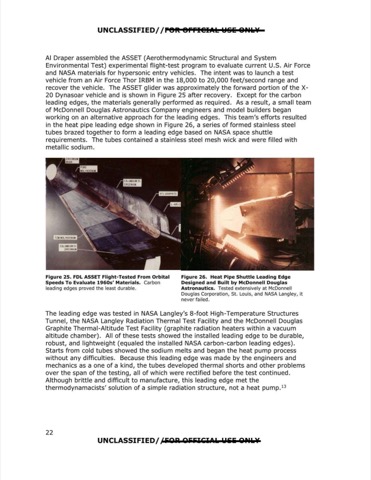
Image from page 29 of DOW-UAP-D124, as released by war.gov
Image from page 29 of the PDF. Open the scan to see the whole page.

Cite this page

U.S. Department of War. "AAWSAP DIRD, Space Access: Where We’ve Been and Where We Could Go, March 2010" (DOW-UAP-D124). PURSUE Release 06, U.S. Department of War, September 18, 2026. https://www.war.gov/medialink/ufo/sept-18/release-06/assets/DOW-UAP-D124_AAWSAP-DIRD-Space%20Access-Where-Weve-Been-and-Where-We-Could-Go-March-8-2010.pdf. Declassified UAP, page 29, https://declassifieduap.org/r/dow-uap-d124-aawsap-dird-space-access-where-weve-been-and-where-we-could-go-march-2010/p/29. Accessed November 28, 2026.

This address shows page 29 on its own; /r/dow-uap-d124-aawsap-dird-space-access-where-weve-been-and-where-we-could-go-march-2010?page=29 opens the same page in the full reader. Both stay. How to cite.