DOW-UAP-D124

AAWSAP DIRD, Space Access: Where We’ve Been and Where We Could Go, March 2010, page 28

One page of a U.S. government record released under PURSUE, shown on its own with its text. The record page has the whole document, its catalog details and the scan.

Page
28 of 56
Agency
Department of War
Released
Release 06, September 18, 2026

Text of page 28

UNCLASSIFIED//FOR USE ONLY One of the difficulties with silicon carbide (SiC) is that it is ridged fibers, like very-small- diameter rods. When the NASP team visited Japan in 1988, one of the very interesting products of the UBE Corporation was Tyranno® cloth (see Figure 23). Composed of strong, flexible fibers from natural Feldspar, Tyranno cloth handled and felt like tweed cloth. The cloth could be wetted by liquid aluminum or titanium, and the NASP team saw examples of both aluminum and titanium metal matrix composite (MMC) products. For example, an aluminum MMC piston and connecting rod was being used in Kawasaki racing engines. And a powder form of aluminum MMC was being used as a dry pigment that was fused onto the surface of Kawasaki motorcycle mufflers. The MDC NASP team foresaw many applications for Tyranno cloth for its NASP aircraft. Figure 22. This 1988 SEP Bordeaux SiC/SiC Panel Could Sustain Temperatures of up to 3,000 °F. With SEP having subsequently closed, little of this capability remains. Figure 23. UBE Corporation's Tyranno Cloth. The cloth was used industrially in Japan. The FDL-7 and Model 176 configurations always elicit comments that their sharpness and the associated high heating rates make them nonviable concepts. However, that is not the case. Figure 24 shows a 1-inch- diameter, sintered-nickel nose tip attached to a 1,000-psi water tank that sweats water. The result is a functional sharp, low-drag nose with a minimum-thickness entropy boundary layer. 12 This tip was flight-tested on a hypersonic glider (BGRV flight in 1966) beginning at about 22,000 feet/second. Today, Aerojet Sacramento's platelet diffusion-bonding technique would make this a much easier task. Some experimental evidence from the BGRV flight Figure 24. A Porous Nickel Tip Oozing Water. This test lasted 4,300 seconds before the arc heater cathode-not the nose tip-failed. indicates the water vapor film in the boundary did act to reduce the heat transfer to the body aft of the nose. 21 UNCLASSIFIED/ /FOR OFFT AL USE ONLY

Machine-read (OCR) from the scan by this archive; it can contain errors. The scan is the record.
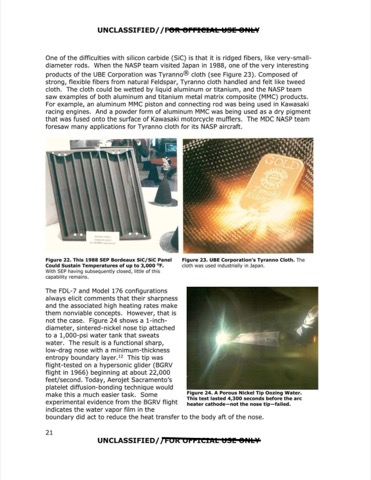
Image from page 28 of DOW-UAP-D124, as released by war.gov
Image from page 28 of the PDF. Open the scan to see the whole page.

Cite this page

U.S. Department of War. "AAWSAP DIRD, Space Access: Where We’ve Been and Where We Could Go, March 2010" (DOW-UAP-D124). PURSUE Release 06, U.S. Department of War, September 18, 2026. https://www.war.gov/medialink/ufo/sept-18/release-06/assets/DOW-UAP-D124_AAWSAP-DIRD-Space%20Access-Where-Weve-Been-and-Where-We-Could-Go-March-8-2010.pdf. Declassified UAP, page 28, https://declassifieduap.org/r/dow-uap-d124-aawsap-dird-space-access-where-weve-been-and-where-we-could-go-march-2010/p/28. Accessed November 28, 2026.

This address shows page 28 on its own; /r/dow-uap-d124-aawsap-dird-space-access-where-weve-been-and-where-we-could-go-march-2010?page=28 opens the same page in the full reader. Both stay. How to cite.