DOW-UAP-D124

AAWSAP DIRD, Space Access: Where We’ve Been and Where We Could Go, March 2010, page 24

One page of a U.S. government record released under PURSUE, shown on its own with its text. The record page has the whole document, its catalog details and the scan.

Page
24 of 56
Agency
Department of War
Released
Release 06, September 18, 2026

Text of page 24

UNCLASSIFIED/ FOR I AL USE ONLY Aero Heating 97.5% Radiated to Space metal shingle vacuum multi- layer insulation diffusion bonded super-plastically formed structure Figure 6.1 McDonnell manium structure. (Courtesy of John Rohson) Figure 16. McDonnell Aircraft Company Roll-Bonded Titanium Structure (circa 1963). Today this structure would be super-plastically formed and diffusion bonded from RSR titanium sheets. 11 Mulready's book mentions the McDonnell Douglas boost-glide strategic vehicle, as well as citing key personnel at McDonnell Aircraft Company. Low thermal conductivity standoffs set off the insulated-metal, thermal-protection-insulated shingles from this wall so that there was an air gap between them. The X-33 applied the metal shingle concept, albeit with significant improvement in the standoff design and thermal leakage, in the orientation, thickness, and weight of the shingles. This is one aspect of the X-33 that can be applied to future spacecraft for a more reliable and repairable thermal protection system than ceramic tiles. All efforts by the author to obtain information on the shingles manufactured by Goodrich Aerospace have been met with the response, "We lost the contract and are investing in more productive products." The titanium diffusion-bonded and super-plastically formed wall was both the primary aircraft structure and the propellant tank wall. The cryogenic propellants were isolated from the metal wall by a metal foil barrier and sealed insulation on the inside of the propellant tank. Significant testing of this structural approach confirmed its superior capabilities as a hypersonic radiation-cooled structure. The Model 176 was proposed for the Manned Orbiting Laboratory. It was a thoroughly designed and tested configuration with a complete, all-metal thermal-protection system that had the same weight as ceramic tile and carbon-carbon concepts used for the U.S. space shuttle but was sturdier and could be repaired in a hanger or in orbit. A wind 17 UNCLASSIFIED//FOR AL USE ONLY

Machine-read (OCR) from the scan by this archive; it can contain errors. The scan is the record.
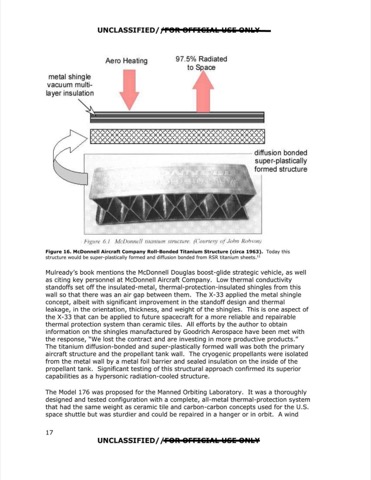
Image from page 24 of DOW-UAP-D124, as released by war.gov
Image from page 24 of the PDF. Open the scan to see the whole page.

Cite this page

U.S. Department of War. "AAWSAP DIRD, Space Access: Where We’ve Been and Where We Could Go, March 2010" (DOW-UAP-D124). PURSUE Release 06, U.S. Department of War, September 18, 2026. https://www.war.gov/medialink/ufo/sept-18/release-06/assets/DOW-UAP-D124_AAWSAP-DIRD-Space%20Access-Where-Weve-Been-and-Where-We-Could-Go-March-8-2010.pdf. Declassified UAP, page 24, https://declassifieduap.org/r/dow-uap-d124-aawsap-dird-space-access-where-weve-been-and-where-we-could-go-march-2010/p/24. Accessed November 28, 2026.

This address shows page 24 on its own; /r/dow-uap-d124-aawsap-dird-space-access-where-weve-been-and-where-we-could-go-march-2010?page=24 opens the same page in the full reader. Both stay. How to cite.