DOW-UAP-D124

AAWSAP DIRD, Space Access: Where We’ve Been and Where We Could Go, March 2010, page 25

One page of a U.S. government record released under PURSUE, shown on its own with its text. The record page has the whole document, its catalog details and the scan.

Page
25 of 56
Agency
Department of War
Released
Release 06, September 18, 2026

Text of page 25

UNCLASSIFIED//FO AL USE ONLT tunnel model of the McDonnell Douglas Astronautics Company Model 176 installed in the McDonnell Aircraft Company Hypersonic Impulse Tunnel for a heat transfer mapping test is shown in Figure 17. Note that, conforming to the piloting concepts of the 1960s, it has a clearly distinct windshield. The model accomplished thermal mapping to determine the heat transfer distributions on the body and upper fins. Figure 17. Model 176 in the McDonnell Douglas Hypervelocity Impulse Tunnel (circa 1964) for Thermographic Phosphor Heat Transfer Mapping, Including the Upper Fin. Among the important determinations that resulted from these heat transfer tests was that the sharp-leading-edge, flat-bottomed, trapezoidal cross section reduced the heating to the sides and upper surfaces, as shown in Figure 18. In the range of angles of attack corresponding to maximum hypersonic L/D ratio, the sharp leading-edge corner separates and reduces the upper surface heating. Because of this separation, the isotherms are parallel to the lower surface and are 2,100 to 2,400 °F (1,149 to 1,316 °C) cooler than on the compression surface. The upper control fins are hot, but there are approaches and materials applicable to control surfaces. The temperatures shown are radiation equilibrium temperatures. With nose water transpiration cooling (demonstrated in a flight test in 1966) and heat pipe leading edges (demonstrated at NASA Langley in 1967-68), the temperatures of the nose and leading edges are 212 °F and 1,300 ° (100 °C and 704 °C ), respectively. The thermal mapping enabled identification of primary flow characteristics in the boundary layer of the vehicle. In 18 UNCLASSIFIED/ /EOR OFFICI AL USE ONLY

Machine-read (OCR) from the scan by this archive; it can contain errors. The scan is the record.
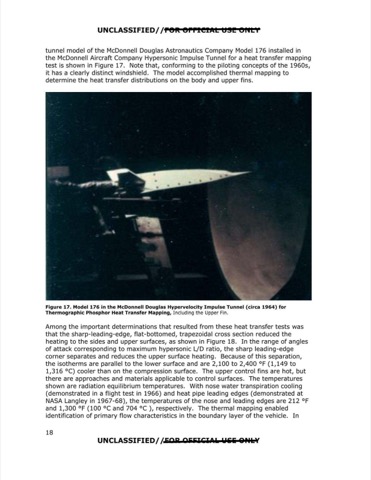
Image from page 25 of DOW-UAP-D124, as released by war.gov
Image from page 25 of the PDF. Open the scan to see the whole page.

Cite this page

U.S. Department of War. "AAWSAP DIRD, Space Access: Where We’ve Been and Where We Could Go, March 2010" (DOW-UAP-D124). PURSUE Release 06, U.S. Department of War, September 18, 2026. https://www.war.gov/medialink/ufo/sept-18/release-06/assets/DOW-UAP-D124_AAWSAP-DIRD-Space%20Access-Where-Weve-Been-and-Where-We-Could-Go-March-8-2010.pdf. Declassified UAP, page 25, https://declassifieduap.org/r/dow-uap-d124-aawsap-dird-space-access-where-weve-been-and-where-we-could-go-march-2010/p/25. Accessed November 28, 2026.

This address shows page 25 on its own; /r/dow-uap-d124-aawsap-dird-space-access-where-weve-been-and-where-we-could-go-march-2010?page=25 opens the same page in the full reader. Both stay. How to cite.