DOW-UAP-D124

AAWSAP DIRD, Space Access: Where We’ve Been and Where We Could Go, March 2010, page 23

One page of a U.S. government record released under PURSUE, shown on its own with its text. The record page has the whole document, its catalog details and the scan.

Page
23 of 56
Agency
Department of War
Released
Release 06, September 18, 2026

Text of page 23

10 UNCLASSIFIED// FOR OFFICIAL USE ONLY Minimum Acceptable Initial Speed Based on Accelerated Stall Margin Psychological Limit Due • to Excessive Initial Speed 8 Subsonic Lift-to-Drag Ratio Model 176 6 Dynasost 4 X-15 13° Half-Cone - 2 Limit Due to Margin Flare Capability 0 100 120 140 160 180 200 220 240 Flare Initiation Speed (percent of minimum speed) %Vmin Figure 15. Both Delta Planform Lifting Body (Dynasoar) and Model 176 Offer Superior Landing 260 Performance Thermodynamics and Materials The structure of Model 176 was based on diffusion-bonding and super-plastic forming of flat titanium sheets. Forty years ago, the method was called "roll bonding" and executed with the titanium sealed within an evacuated steel envelope and processed in a steel rolling plant. With a lot of effort and chemical leaching, the titanium part was freed from its steel enclosure. All of that has been completely replaced today by the current titanium diffusion-bonding and super-plastic forming industrial capabilities. The photo in Figure 16 is from a Society of Automotive Engineers book titled Advanced Engine Development at Pratt & Whitney: The Inside Story of Eight Special Projects 146- 1971, by Dick Mulready. Chapter 6, "Boost Glide and the XLR-129 - mach 20 at 200,000 Feet," shows a surviving remnant from the 1960s program. The super-plastic-forming, diffusion bonding that was so difficult in early 1960 is now an accepted fabrication procedure. One of the F-15's major bulkheads was fabricated from titanium sheet elements using this procedure instead of machining away more than 90 percent of a titanium forging. Had the procedure been adopted as a product- manufacturing method, it would have eliminated the almost 2-year manufacturing cycle in acquiring titanium forging of the wing spars and major bulkheads. Note that only 2.5 percent of the thermal heating enters the primary structure. 16 UNCLASSIFIED/ FOR OFFY AL LISE ONLY

Machine-read (OCR) from the scan by this archive; it can contain errors. The scan is the record.
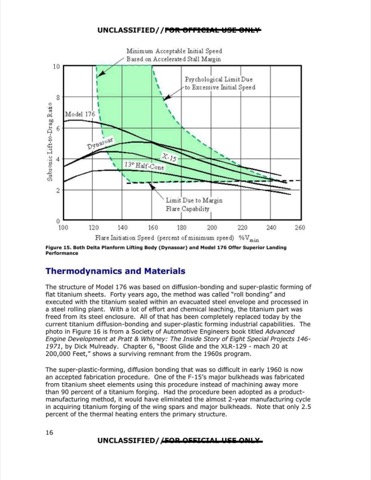
Image from page 23 of DOW-UAP-D124, as released by war.gov
Image from page 23 of the PDF. Open the scan to see the whole page.

Cite this page

U.S. Department of War. "AAWSAP DIRD, Space Access: Where We’ve Been and Where We Could Go, March 2010" (DOW-UAP-D124). PURSUE Release 06, U.S. Department of War, September 18, 2026. https://www.war.gov/medialink/ufo/sept-18/release-06/assets/DOW-UAP-D124_AAWSAP-DIRD-Space%20Access-Where-Weve-Been-and-Where-We-Could-Go-March-8-2010.pdf. Declassified UAP, page 23, https://declassifieduap.org/r/dow-uap-d124-aawsap-dird-space-access-where-weve-been-and-where-we-could-go-march-2010/p/23. Accessed November 28, 2026.

This address shows page 23 on its own; /r/dow-uap-d124-aawsap-dird-space-access-where-weve-been-and-where-we-could-go-march-2010?page=23 opens the same page in the full reader. Both stay. How to cite.