DOW-UAP-D124

AAWSAP DIRD, Space Access: Where We’ve Been and Where We Could Go, March 2010, page 22

One page of a U.S. government record released under PURSUE, shown on its own with its text. The record page has the whole document, its catalog details and the scan.

Page
22 of 56
Agency
Department of War
Released
Release 06, September 18, 2026

Text of page 22

UNCLASSIFIED// FOR eFf AL USE ONLY Figure 14 compares the glide ranges and L/D ratios of selected hypersonic gliders. The shuttle would be in the area of the nominal wing body on the righthand chart. From Figure 13, the no-waiting cross range (lateral range) is 3,600 to 4,400 nautical miles. That means the hypersonic L/D ratio needs to be in the 2.7 to 3.2 range. Appendix D has down and lateral ranges shown as landing ellipses. The key to a successful landing is a subsonic L/D ratio that is in the 4.5-or-greater range. The NASA round-bottom configurations were not capable of that subsonic L/D ratio. The X-24B was in that category and was therefore easily landed compared with the X-24A or Prime vehicles. These high-performance gliders were unique to the AFFDL. The intent in case of a fire would be to immediately evacuate to the hypersonic gliders and then depressurize the station to control any fire (remember that Mercury and Gemini could be depressurized). A crew could then be launched to recover the operation and repair the station. 30,000 Down Range (nautical miles) Model 176 4.0 - MDC data Model 176 3.0 20,000 Nominal Lifting Body DynaSoar 2.0 Wing-Body 10,000 1.0 • Eggers M2 • Apollo + Paraglider 0 0 2.0 4.0 5.0 Subsonic L/D 6.0 0 2,000 4,000 Lateral Range (nautical miles) 6,000 3.0 7.0 Figure 14. Hypersonic Glider Characteristics There is always the question about landing these blended bodies. Figure 15 shows the blended body handling qualities to be very good, and therefore a pilot's fear factor is less than with the X-15. Bill Dana said the X-24A was difficult to handle when landing but that he could land the X-24B almost with no hands as it flared automatically. To the author's knowledge, all of the wind tunnel tests showed inherent static and dynamic stability over the entire speed range. 15 UNCLASSIFIED/ /EOR DEFICIAL USE ONLY

Machine-read (OCR) from the scan by this archive; it can contain errors. The scan is the record.
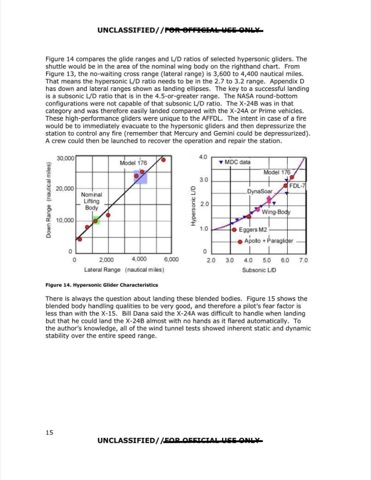
Image from page 22 of DOW-UAP-D124, as released by war.gov
Image from page 22 of the PDF. Open the scan to see the whole page.

Cite this page

U.S. Department of War. "AAWSAP DIRD, Space Access: Where We’ve Been and Where We Could Go, March 2010" (DOW-UAP-D124). PURSUE Release 06, U.S. Department of War, September 18, 2026. https://www.war.gov/medialink/ufo/sept-18/release-06/assets/DOW-UAP-D124_AAWSAP-DIRD-Space%20Access-Where-Weve-Been-and-Where-We-Could-Go-March-8-2010.pdf. Declassified UAP, page 22, https://declassifieduap.org/r/dow-uap-d124-aawsap-dird-space-access-where-weve-been-and-where-we-could-go-march-2010/p/22. Accessed November 28, 2026.

This address shows page 22 on its own; /r/dow-uap-d124-aawsap-dird-space-access-where-weve-been-and-where-we-could-go-march-2010?page=22 opens the same page in the full reader. Both stay. How to cite.