Text of page 21
UNCLASSIFIED/ FOR
AL USE ONLY
The author was aware of three people-James S. McDonnell, the AFFDL's Albert Draper,
and Russia's Glebe Lozino-Lozinski-who clearly understood the need for a long cross-
range and down-range capability, not just for one missed orbit. Critics will observe that
Lozino-Lozinski had limited his BOR vehicles to an L/D ratio of 1.7 to 1.8 and not the
2.7 to 3.0 required for Earth circumferential glide range. First, the longitudinal extent
of the former Soviet Union was twice that of CONUS, and an Earth circumferential glide
range was not necessary to ensure recovery within the continental Soviet Union;
therefore, a lesser L/D ratio was acceptable. Second, in personal conversations with
the author, Lozino-Lozinski indicated a Russian government agency forced him to limit
the glide range to ensure recovery in continental Russia and prevent escape to the
United States. In a further step to prevent escape, when the vehicle was in range of
CONUS, ground control disabled its deorbit system.
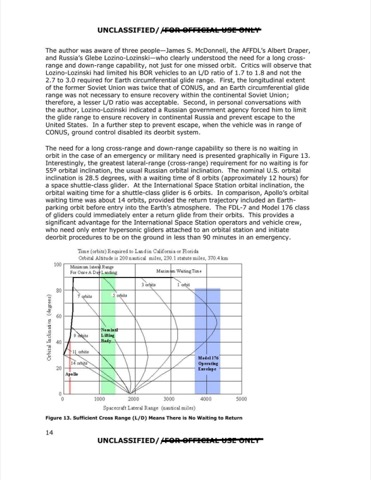
The need for a long cross-range and down-range capability so there is no waiting in
orbit in the case of an emergency or military need is presented graphically in Figure 13.
Interestingly, the greatest lateral-range (cross-range) requirement for no waiting is for
55° orbital inclination, the usual Russian orbital inclination. The nominal U.S. orbital
inclination is 28.5 degrees, with a waiting time of 8 orbits (approximately 12 hours) for
a space shuttle-class glider. At the International Space Station orbital inclination, the
orbital waiting time for a shuttle-class glider is 6 orbits. In comparison, Apollo's orbital
waiting time was about 14 orbits, provided the return trajectory included an Earth-
parking orbit before entry into the Earth's atmosphere. The FDL-7 and Model 176 class
of gliders could immediately enter a return glide from their orbits. This provides a
significant advantage for the International Space Station operators and vehicle crew,
who need only enter hypersonic gliders attached to an orbital station and initiate
deorbit procedures to be on the ground in less than 90 minutes in an emergency.
100
Time (orbits) Required to Land in California or Florida
Orbital Altitude is 200 nautical miles, 230.1 statute miles, 370.4 km
Minimum lateral Range
For Once A Day Landing
Maximum Waiting Time
3 orbits
1 orbit
Orbital Inclination (degrees)
80
orbits
5 orbits
60
)
40
20
9 orbits
*11 orbits
14 orbits
Apollo
Nominat
Lifting
Rady
Model 176
Operating
Envelope
1000
2000
3000
4000
5000
Spacecraft Lateral Range (nautical miles)
Figure 13. Sufficient Cross Range (L/D) Means There is No Waiting to Return
14
UNCLASSIFIED/ /FOR OFFICIAL USE ONLY