DOW-UAP-D124

AAWSAP DIRD, Space Access: Where We’ve Been and Where We Could Go, March 2010, page 18

One page of a U.S. government record released under PURSUE, shown on its own with its text. The record page has the whole document, its catalog details and the scan.

Page
18 of 56
Agency
Department of War
Released
Release 06, September 18, 2026

Text of page 18

UNCLASSIFIED/ FOR Complex curved TPS system AL USE ONLY Glide angle of attack very high ~ 45° compared to 15° for high L/D design NASA Langley Wing-Cylinder Configuration Concept WB-004 Inadequate lateral-directional stability and control Unsymmetrical vortices can produce super- sonic control problems Cylinder heating extends up to 55° to 60° Poor hypersonic lift-to-drag ratio limits glide range Wing training edge controls provide limited control capability for a military maneuver vehicle Thin wings encounter severe heating from both sides i.e. "hot structure" Figure 9. NASA Langley Wing-Body Configuration WB-004 With Generally Critical Areas for Wing Bodies Identified With a high entry angle of attack, the cross flow over the cylinder produces high heating rates beyond the mid-cylinder line. With a lower L/D ratio, the down and cross ranges are limited as to what might be achieved but more in line with NASA one- missed-orbit criterion. The thin wings are heated on both sides to create added thermal problems, as well as added surface area to increase drag. Al Draper and his team, together with Bob Masek's team at McDonnell Douglas Astronautics, worked long and diligently to arrive at the FDL-7/Model 176 configurations shown in Figure 10. The insert photo is Dale Reed's model of the FDL- 7MC radio-controlled model at NASA Dryden. The AFFDL and MDC configurations were inherently stable at all operational angles of attack from at least mach 22 to landing speed. The remainder of this report will focus on the characteristics of this class of lifting body. The statements in Figure 10 were all based on wind tunnel data. A real advantage of the trapezoidal shape was not only flat metallic shingles but heating on the sides and upper surface that was at least three-fifths that of the conventional shapes. The glide range was such that this configuration could land in CONUS from any location on any inclination orbit from its current orbit with no waiting. 11 UNCLASSIFIED//FOR OFFICIAL USE ONLY

Machine-read (OCR) from the scan by this archive; it can contain errors. The scan is the record.
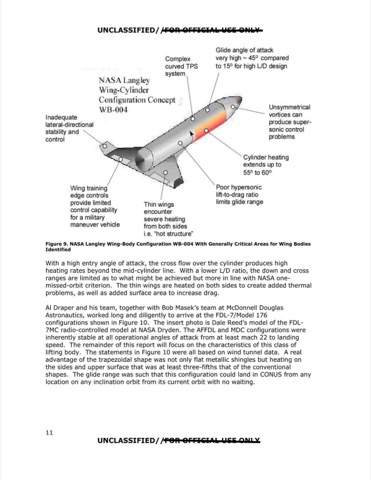
Image from page 18 of DOW-UAP-D124, as released by war.gov
Image from page 18 of the PDF. Open the scan to see the whole page.

Cite this page

U.S. Department of War. "AAWSAP DIRD, Space Access: Where We’ve Been and Where We Could Go, March 2010" (DOW-UAP-D124). PURSUE Release 06, U.S. Department of War, September 18, 2026. https://www.war.gov/medialink/ufo/sept-18/release-06/assets/DOW-UAP-D124_AAWSAP-DIRD-Space%20Access-Where-Weve-Been-and-Where-We-Could-Go-March-8-2010.pdf. Declassified UAP, page 18, https://declassifieduap.org/r/dow-uap-d124-aawsap-dird-space-access-where-weve-been-and-where-we-could-go-march-2010/p/18. Accessed November 28, 2026.

This address shows page 18 on its own; /r/dow-uap-d124-aawsap-dird-space-access-where-weve-been-and-where-we-could-go-march-2010?page=18 opens the same page in the full reader. Both stay. How to cite.