DOW-UAP-D124

AAWSAP DIRD, Space Access: Where We’ve Been and Where We Could Go, March 2010, page 19

One page of a U.S. government record released under PURSUE, shown on its own with its text. The record page has the whole document, its catalog details and the scan.

Page
19 of 56
Agency
Department of War
Released
Release 06, September 18, 2026

Text of page 19

UNCLASSIFIED//TOR USE ONLY Flight tested nose tip design assures 100 °C temperature Lifting body configuration eliminates thin wings with wing-like lift. High lift-to-drag ratio and global glide range AFFDL-7C/D Lifting Body Configuration Concept All-flying control surfaces provide stability and control from Mach 0.2 to 22 • Heat pipe leading edges assures high L/D leading edge radii. Flat pane TPS system Dale Reed NASA Dryden circa 1967 Trapezoidal cross section increases lift-to-drag ratio and reduces side and upper surface heating by 1/3 Anhedral fixed fins with trailing edge flaps assure subsonic lateral-directional stability and control Figure 10. FDL-7C/D and FDL-7MC Lifting-Body Configuration. Offers inherent stability and control with sufficient volume and high lift-to-drag ratio. The switchblade wing version of the FDL-7MC was the preferred version for 1983 studies that were part of the McDonnell Douglas TAV (transatmospheric vehicle) effort; that vehicle was powered by either an Aerojet Sacramento air turboramjet or an air- breathing rocket propulsion system. The inward-turning, variable-capture area inletio provides the correct engine airflow from landing speeds to mach 5.5, as illustrated in Figure 11. Figure 11. FDL-7C/D with a DuPont Retractable Inward-Turning Inlet The propellant tanks were cylindrical-segment, multilobe structures with bulkheads and stringers to support the flat, metal-radiative thermal-protection shingles (very similar to those fabricated by Goodrich Aerospace for the now-defunct X-33). The nose was 12 UNCLASSIFIED/ FOR OFFICIAL USE ONLY

Machine-read (OCR) from the scan by this archive; it can contain errors. The scan is the record.
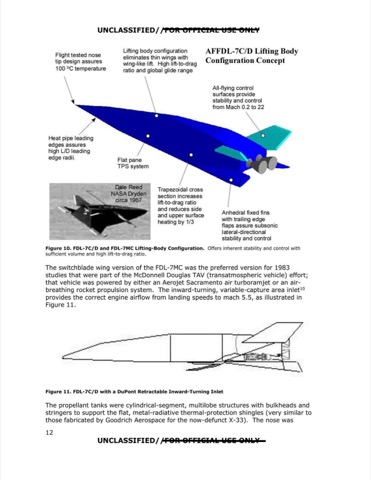
Image from page 19 of DOW-UAP-D124, as released by war.gov
Image from page 19 of the PDF. Open the scan to see the whole page.

Cite this page

U.S. Department of War. "AAWSAP DIRD, Space Access: Where We’ve Been and Where We Could Go, March 2010" (DOW-UAP-D124). PURSUE Release 06, U.S. Department of War, September 18, 2026. https://www.war.gov/medialink/ufo/sept-18/release-06/assets/DOW-UAP-D124_AAWSAP-DIRD-Space%20Access-Where-Weve-Been-and-Where-We-Could-Go-March-8-2010.pdf. Declassified UAP, page 19, https://declassifieduap.org/r/dow-uap-d124-aawsap-dird-space-access-where-weve-been-and-where-we-could-go-march-2010/p/19. Accessed November 28, 2026.

This address shows page 19 on its own; /r/dow-uap-d124-aawsap-dird-space-access-where-weve-been-and-where-we-could-go-march-2010?page=19 opens the same page in the full reader. Both stay. How to cite.