DOW-UAP-D124

AAWSAP DIRD, Space Access: Where We’ve Been and Where We Could Go, March 2010, page 17

One page of a U.S. government record released under PURSUE, shown on its own with its text. The record page has the whole document, its catalog details and the scan.

Page
17 of 56
Agency
Department of War
Released
Release 06, September 18, 2026

Text of page 17

UNCLASSIFIED//FOR eFFICI AL USE ONLY goal was to be able to recover the spacecraft at any airport in CONUS, to eliminate the need for an overseas recovery site, and to eliminate the waiting required until a lower L/D ratio could land in CONUS (up to 14 orbits for the Apollo capsule, or 21 hours). In an emergency, that may be too long. The AFFDL's goal for the spacecraft to support the Manned Orbiting Laboratory was no waiting but to be able to reach CONUS from any arbitrary MOL position in its orbit. This was considered possible in the 1964-65 briefs to the government with respect to MOL, specifically the Model 176 configuration the MDC proposed for the MOL support in 1964. The hypersonic glider based on the FDL-7C and the hypersonic air-breathing aircraft in Figure 8 both have hypersonic L/D ratios in excess of 2.7. In very practical terms, that means unpowered cross ranges in excess of 4,500 nautical miles and down ranges on the order of the Earth's circumference. So these two craft can depart from any location of a low-altitude orbit and land in CONUS or in continental Europe. Both are dynamically stable over the entire glide regime. FDL-7 C/D Hypersonic Glider Blended Body Hypersonic Cruiser Figure 8. High-Performance Hypersonic Glide Aircraft. Rocket boost-glide and air-breather cruiser. The wing-body, cylindrical fuselage advocates have strongly criticized the lifting bodies, contending that they are poorer configurations and much more complicated than the conventional-wisdom wing-body configurations (see Figure 9). However, that is far from the truth. The structural specialist sees this configuration as a lightweight propellant tank and assumes it is this consideration that drives the design. Rather, that observation introduces problems for all other technical disciplines that are far more difficult to rectify than a noncylindrical tank or a cylindrical tank in a nonsymmetrical cross section. The lone lifting surface with trailing edge controls introduces control issues just as it did for the space shuttle. 10 UNCLASSIFIED/ /FOR OFFICIAL USE ONLY

Machine-read (OCR) from the scan by this archive; it can contain errors. The scan is the record.
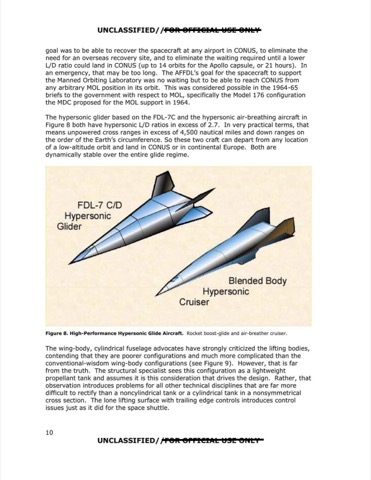
Image from page 17 of DOW-UAP-D124, as released by war.gov
Image from page 17 of the PDF. Open the scan to see the whole page.

Cite this page

U.S. Department of War. "AAWSAP DIRD, Space Access: Where We’ve Been and Where We Could Go, March 2010" (DOW-UAP-D124). PURSUE Release 06, U.S. Department of War, September 18, 2026. https://www.war.gov/medialink/ufo/sept-18/release-06/assets/DOW-UAP-D124_AAWSAP-DIRD-Space%20Access-Where-Weve-Been-and-Where-We-Could-Go-March-8-2010.pdf. Declassified UAP, page 17, https://declassifieduap.org/r/dow-uap-d124-aawsap-dird-space-access-where-weve-been-and-where-we-could-go-march-2010/p/17. Accessed November 28, 2026.

This address shows page 17 on its own; /r/dow-uap-d124-aawsap-dird-space-access-where-weve-been-and-where-we-could-go-march-2010?page=17 opens the same page in the full reader. Both stay. How to cite.