Text of page 14
UNCLASSIFIED/TOR
AL Ust oNtY
Air Force in 1964, and elements of that configuration will be shown later. The intent
was a 9- to 12-person vehicle for crew rotation that could alternatively carry supplies to
the orbital station on a regular, frequent schedule (about one flight per week per
vehicle). The variable geometry switchblade wing permitted landing with heavy loads
returning from space and eventually horizontal takeoff. The experimentally determined
configuration feature was the tail configuration. This configuration was wind tunnel
tested and demonstrated inherent stability and control at speeds ranging from mach 22
to landing speed.
Configuration 6 was a product of cooperation between the AFFDL (Richard D. Neumann)
and McDonnell Douglas Astronautics Company (Robert Krieger) to reduce the drag of
hypersonic gliders. Based on the physics that a two-dimensional wedge has less drag
than a right circular cone of the same volume, these engineers devised the "spatular
leading edge." The wind-body configuration formed the basis of the X-20 and DynaSoar
configurations that had a limited hypersonic L/D ratio, primarily because of drag. With
the spatular nose, the nose wave drag could be reduced by 35 to 40 percent, thus
increasing the hypersonic L/D ratio. Configuration 6 was derived from the conventional
wing body, configuration 5.
Configuration 10 is an adaptation of the Russian "Star Body" concept that can enter in
one of three orientations and need not always have one side facing the flow
(compression side). The theory was that in a damaged situation, one of the three sides
would be available for a safe entry. The limitation of this configuration concept is a
small internal volume and a high ratio of wetted (surface) area per planform area that
reduces the hypersonic L/D ratio.
The X-24B was based on the FDL-8
Martin Maretta
X-23 Д
configuration. The different approaches
to hypersonic glider configuration are
best exemplified by Figure 6. The X-
24A, built by Martin Marietta at its
Denver, Colorado, facilities, is a round
fuselage configuration with outboard
The Xande
high-dihedral-angle vertical tails. All
the configurations of this type have
serious lateral-directional stability
problems at low speeds and tend to roll
about the horizontal axis through the
fuselage. One designer, the Russian
Glebe Lozino-Lozinski, solved the
problem by employing variable dihedral
tails. The AFFDL solved the problem by
Crown toy Mite Wagner
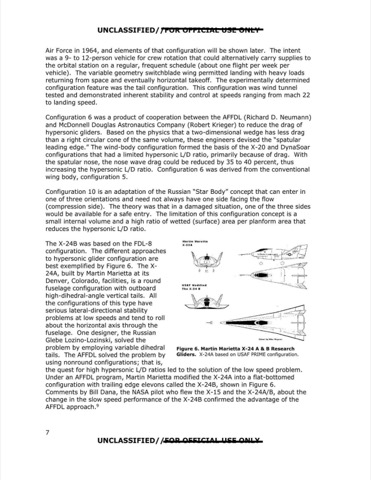
Figure 6. Martin Marietta X-24 A & B Research
Gliders. X-24A based on USAF PRIME configuration.
using nonround configurations; that is,
the quest for high hypersonic L/D ratios led to the solution of the low speed problem.
Under an AFFDL program, Martin Marietta modified the X-24A into a flat-bottomed
configuration with trailing edge elevons called the X-24B, shown in Figure 6.
Comments by Bill Dana, the NASA pilot who flew the X-15 and the X-24A/B, about the
change in the slow speed performance of the X-24B confirmed the advantage of the
AFFDL approach.?
7
UNCLASSIFIED//FOR
AL USE ONLY