Text of page 13
UNCLASSIFIED/ FOR OFFICIAL USE ONLY
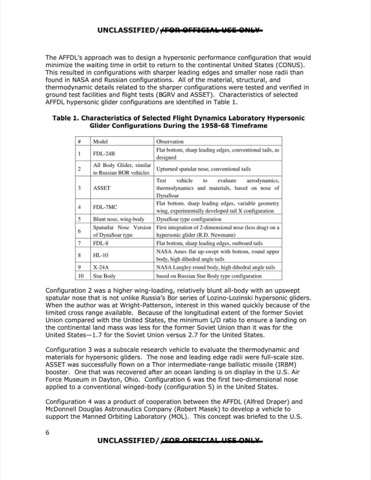
The AFFDL's approach was to design a hypersonic performance configuration that would
minimize the waiting time in orbit to return to the continental United States (CONUS).
This resulted in configurations with sharper leading edges and smaller nose radii than
found in NASA and Russian configurations. All of the material, structural, and
thermodynamic details related to the sharper configurations were tested and verified in
ground test facilities and flight tests (BGRV and ASSET). Characteristics of selected
AFFDL hypersonic glider configurations are identified in Table 1.
Table 1. Characteristics of Selected Flight Dynamics Laboratory Hypersonic
Glider Configurations During the 1958-68 Timeframe
#
1
2
3
4
5
6
7
8
9
10
Model
Observation
Flat bottom, sharp leading edges, conventional tails, as
FDL-24B
All Body Glider, similar
to Russian BOR vehicles
designed
Upturned spatular nose, conventional tails
Test vehicle to evaluate
aerodynamics,
ASSET
thermodynamics and materials, based on nose of
FDL-7MC
Blunt nose, wing-body
Spaturlar Nose Version
of DynaSoar type
FDL-8
HL-10
111000
Flat bottom, sharp leading edges, variable geometry
wing, experimentally developed tail X configuration
DynaSoar type configuration
First integration of 2-dimensional nose (less drag) on a
hypersonic glider (R.D. Newmann)
Flat bottom, sharp leading edges, outboard tails
NASA Ames flat up-swept with bottom, round upper
body, high dihedral angle tails
X-24A
NASA Langley round body, high dihedral angle tails
Star Body
based on Russian Star Body type configuration
Configuration 2 was a higher wing-loading, relatively blunt all-body with an upswept
spatular nose that is not unlike Russia's Bor series of Lozino-Lozinski hypersonic gliders.
When the author was at Wright-Patterson, interest in this waned quickly because of the
limited cross range available. Because of the longitudinal extent of the former Soviet
Union compared with the United States, the minimum L/D ratio to ensure a landing on
the continental land mass was less for the former Soviet Union than it was for the
United States—1.7 for the Soviet Union versus 2.7 for the United States.
Configuration 3 was a subscale research vehicle to evaluate the thermodynamic and
materials for hypersonic gliders. The nose and leading edge radii were full-scale size.
ASSET was successfully flown on a Thor intermediate-range ballistic missile (IRBM)
booster. One that was recovered after an ocean landing is on display in the U.S. Air
Force Museum in Dayton, Ohio. Configuration 6 was the first two-dimensional nose
applied to a conventional winged-body (configuration 5) in the United States.
Configuration 4 was a product of cooperation between the AFFDL (Alfred Draper) and
McDonnell Douglas Astronautics Company (Robert Masek) to develop a vehicle to
support the Manned Orbiting Laboratory (MOL). This concept was briefed to the U.S.
6
UNCLASSIFIED/ LEOR DEFICIAL USE ONLY