Text of page 15
UNCLASSIFIED//FOR OF
AL USE ONLY
The design parameters that largely determine a spacecraft's weight are its configuration
and the amount of wetted or surface area relative to the planform area. The
hypersonic gliders shown in Figure 5 have differing values of wetted area to planform
area. Another important factor is the presence of wings, such as for configurations 5
and 6, which are wing bodies with a relatively thin wing or no wing, such as the lifting-
body FDL-class hypersonic glider (configurations 2, 4, or 7). In this case the lifting
bodies have a shape advantage that reduces the amount of surface area that is thin or
subject to high heating. In the 1960s, when the U.S. Air Force's high-performance
lifting body was competing with NASA's modest-performance wing body, there was
much debate regarding the weight of these lifting concepts compared with that of a
ballistic capsule (see Appendix A). At that time, with the large sea-recovery fleets,
ballistic capsules were the only entry vehicles in either the United States or the former
Soviet Union. A number of studies in the early-to-mid-1960s attempted to rectify and
quantify the weight of a lifting entry vehicle compared with a ballistic capsule. In all
the discussion in the Mercury, Gemini, and Apollo programs, the cost of the sea
recovery was almost taken for granted, so the focus was on the cost of the vehicle
itself, not the entire vehicle system. The government assembled a chart representing
the relative weight of hypersonic entry systems-from ballistic to high-performance
(high L/D ratio) gliders-collected from contractor and government reports. The
relative weight was the system weight compared with that of a ballistic capsule with the
same payload capacity. The result was a correlation curve that showed the high-
performance wing-body gliders could weigh as much as twice what a comparable
payload ballistic capsule weighed. This correlation was based on the L/D ratio of the
vehicle. Apollo has an L/D ratio of about 0.5, but the system was still a ballistic vehicle
with a very limited cross range. One correlation of the data is:
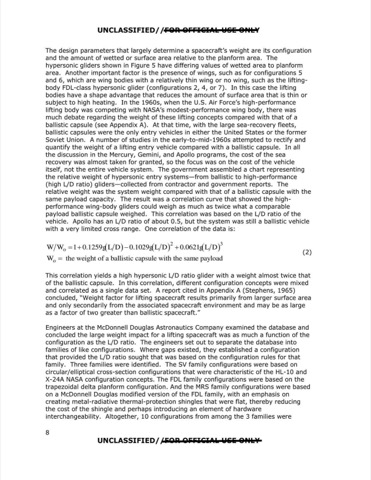
W/W. =1+0.1259€(L/D) -0.1029g(L/D) + 0.0621₫L/D)3
W. = the weight of a ballistic capsule with the same payload
(2)
This correlation yields a high hypersonic L/D ratio glider with a weight almost twice that
of the ballistic capsule. In this correlation, different configuration concepts were mixed
and correlated as a single data set. A report cited in Appendix A (Stephens, 1965)
concluded, "Weight factor for lifting spacecraft results primarily from larger surface area
and only secondarily from the associated spacecraft environment and may be as large
as a factor of two greater than ballistic spacecraft."
Engineers at the McDonnell Douglas Astronautics Company examined the database and
concluded the large weight impact for a lifting spacecraft was as much a function of the
configuration as the L/D ratio. The engineers set out to separate the database into
families of like configurations. Where gaps existed, they established a configuration
that provided the L/D ratio sought that was based on the configuration rules for that
family. Three families were identified. The SV family configurations were based on
circular/elliptical cross-section configurations that were characteristic of the HL-10 and
X-24A NASA configuration concepts. The FDL family configurations were based on the
trapezoidal delta planform configuration. And the MRS family configurations were based
on a McDonnell Douglas modified version of the FDL family, with an emphasis on
creating metal-radiative thermal-protection shingles that were flat, thereby reducing
the cost of the shingle and perhaps introducing an element of hardware
interchangeability. Altogether, 10 configurations from among the 3 families were
8
UNCLASSIFIED/ FOR OFFICIAL USE ONLY