Text of page 26
UNCLASSIFIED//FeR eFFreIAL USE ONLY
NITINOL AS A BIOMATERIAL
The use of nitinol metal in stents is a clever application of the properties of a class of
materials called shape memory alloys (SMAs). SMAs are mixtures of metals that, after
being stress treated, can be deformed significantly but then triggered to return to their
original shape.
SMAs have a rather remarkable
property: they remember their shape.
This "smart" property is the result of
the substance's ability to undergo a
phase change. This occurs at the
atomic level, where atoms in the solid
subtly shift their positions in response
to a stimulus, such as a change in
temperature or the application of
mechanical stress.
Once the metal is formed at a high
temperature it remembers this shape.
Subsequent distortions of the material
when it is cold remain locked in place
while the material remains at a low
temperature. However, warming the
material to a specific temperature that
is relatively closer to its formation
temperature will trigger a return to its
original formed shape.
In stents, the web is collapsed while it
is cold for easy insertion into a blood
vessel and held cold by a flow of cold
saline out of the catheter. When the
stent warms up as the catheter is
removed, it expands itself and the
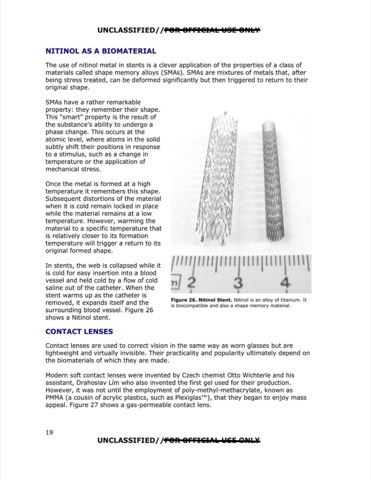
surrounding blood vessel. Figure 26
shows a Nitinol stent.
2
3
4
Figure 26. Nitinol Stent. Nitinol is an alloy of titanium. It
is biocompatible and also a shape memory material.
CONTACT LENSES
Contact lenses are used to correct vision in the same way as worn glasses but are
lightweight and virtually invisible. Their practicality and popularity ultimately depend on
the biomaterials of which they are made.
Modern soft contact lenses were invented by Czech chemist Otto Wichterle and his
assistant, Drahoslav Lim who also invented the first gel used for their production.
However, it was not until the employment of poly-methyl-methacrylate, known as
PMMA (a cousin of acrylic plastics, such as Plexiglas™), that they began to enjoy mass
appeal. Figure 27 shows a gas-permeable contact lens.
19
UNCLASSIFIED//FOR OFFICIAL USE ONLY