Text of page 25
UNCLASSIFIED//T
USE ONLY
Heart valves are another application
of biomaterials in which the materials
are in direct contact with blood. They
are typically constructed using a form
of stainless steel and woven Teflon (or
Dacron) as a suture ring to anchor the
device. Figure 24 shows one of these
devices.
STENT BIOMATERIALS
A stent is a metal mesh tube that
looks something like a Chinese finger
puzzle and is used to prop open a
clogged artery. These are delivered to
the heart in a catheter on the end of a
wire usually inserted into an artery in
the groin.
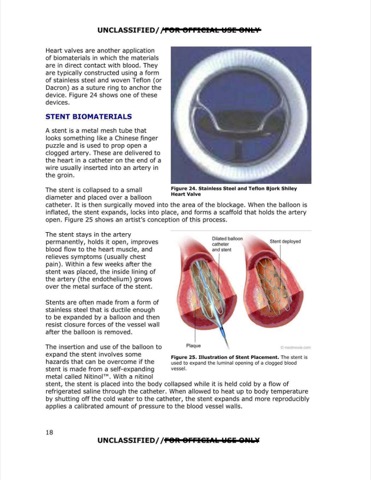
The stent is collapsed to a small
Figure 24. Stainless Steel and Teflon Bjork Shiley
Heart Valve
diameter and placed over a balloon
catheter. It is then surgically moved into the area of the blockage. When the balloon is
inflated, the stent expands, locks into place, and forms a scaffold that holds the artery
open. Figure 25 shows an artist's conception of this process.
The stent stays in the artery
permanently, holds it open, improves
blood flow to the heart muscle, and
relieves symptoms (usually chest
pain). Within a few weeks after the
stent was placed, the inside lining of
the artery (the endothelium) grows
over the metal surface of the stent.
Dilated balloon
catheter
and stent
Stent deployed
Stents are often made from a form of
stainless steel that is ductile enough
to be expanded by a balloon and then
resist closure forces of the vessel wall
after the balloon is removed.
The insertion and use of the balloon to
Plaque
expand the stent involves some
hazards that can be overcome if the
stent is made from a self-expanding
© medmovie.com
Figure 25. Illustration of Stent Placement. The stent is
used to expand the luminal opening of a clogged blood
vessel.
metal called Nitinol™. With a nitinol
stent, the stent is placed into the body collapsed while it is held cold by a flow of
refrigerated saline through the catheter. When allowed to heat up to body temperature
by shutting off the cold water to the catheter, the stent expands and more reproducibly
applies a calibrated amount of pressure to the blood vessel walls.
18
UNCLASSIFIED//F€
USE ONLY