DOW-UAP-D119

AAWSAP DIRD, Biomaterials, January 2010, page 19

One page of a U.S. government record released under PURSUE, shown on its own with its text. The record page has the whole document, its catalog details and the scan.

Page
19 of 32
Agency
Department of War
Released
Release 06, September 18, 2026

Text of page 19

UNCLASSIFIED//FOR USE ONLY Two common ceramics used in dentistry and hip prostheses are alumina and hydroxyapatite (HA). HA is a major component of the inorganic compartment of bone. Commercially prepared HA is processed using a technique of phosphoric acid and hydrothermal exchange that produces a porous, "bone-like" morphology in the resulting structure. Figure 16 shows this result. When implanted into bone defects, HA supports bone growth through the pores and, thus, becomes an intermediate scaffold, as well as an eventual support matrix. Hydroxyapatite composites have been successfully used to repair, reconstruct, and replace diseased or damaged body parts, especially bone. They have been used in vertebral prostheses, intervertebral spacers, bone grafting, middle-ear bone replacements, and jawbone repair. Figure 16. Hydroxyapatite Porous Bone-Like Structure After Commercial Processing Aluminum oxide, or alumina (Al203), has been used in orthopedic surgery for more than 20 years as the joint surface in total hip prostheses because of its exceptionally low coefficient of friction and minimal wear rates. Alumina has excellent corrosion resistance, good biocompatibility, high strength, and high wear resistance, making it ideal for orthopedic applications. Other bioceramics include coral skeletons, which can be transformed into hydroxyapatite by high temperatures. Their porous structure allows relatively rapid ingrowth of living cells at the expense of initial mechanical strength. The high temperature also burns away any organic molecules, such as proteins, preventing graft-versus-host disease and rejection. Bioceramics made from a calcium phosphate material containing tiny pores have been used to coat metal joint implants or as unloaded space fillers for bone ingrowth. Tissue ingrowth into the pores occurs, with Figure 17. Bioceramic Used in Artificial Hip Replacement Component 12 UNCLASSIFIED/ / EAR DEEICIAL USE ONLY

Machine-read (OCR) from the scan by this archive; it can contain errors. The scan is the record.
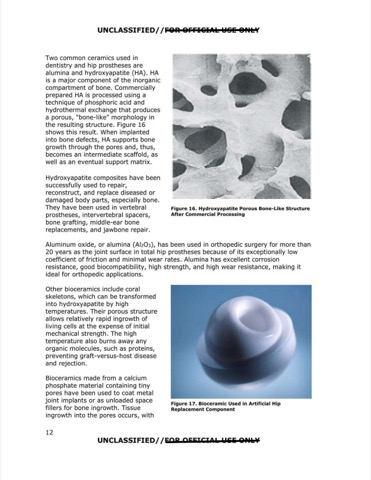
Image from page 19 of DOW-UAP-D119, as released by war.gov
Image from page 19 of the PDF. Open the scan to see the whole page.

Cite this page

U.S. Department of War. "AAWSAP DIRD, Biomaterials, January 2010" (DOW-UAP-D119). PURSUE Release 06, U.S. Department of War, September 18, 2026. https://www.war.gov/medialink/ufo/sept-18/release-06/assets/DOW-UAP-D119_AAWSAP-DIRD-Biomaterials-January-7-2010.pdf. Declassified UAP, page 19, https://declassifieduap.org/r/dow-uap-d119-aawsap-dird-biomaterials-january-2010/p/19. Accessed November 28, 2026.

This address shows page 19 on its own; /r/dow-uap-d119-aawsap-dird-biomaterials-january-2010?page=19 opens the same page in the full reader. Both stay. How to cite.