Text of page 20
UNCLASSIFIED//FOR OrrIa
TAL USE ONLY
an increase in the interfacial area between the implant and the tissues. This tissue
ingrowth results in an increased resistance to device movement within the tissue. As in
natural bone, proteins adsorb to the calcium phosphate surface to provide the critical
intervening layer through which the bone cells interact with the implanted biomaterial.
Figure 17 shows an example of this.
DENTAL CERAMICS
Dental ceramics are a major subclass of biomaterials. Porcelains are hard ceramic
materials that are based on a glass of silica and alumina, with fluxes used to lower their
fusion temperature. Dental porcelains can have a hardness that exceeds that of the
enamel of natural teeth, but they are often more brittle and more likely to fracture.
They also do not have the same optical properties, thermal conductivity, or natural
fluorescence as biological materials.
Full-porcelain (ceramic) dental materials include porcelain, ceramic, or glasslike fillings
and crowns (a metal-free option known as a jacket crown). They are used as inlays,
onlays, crowns, and aesthetic veneers. A veneer is a very thin shell of porcelain that
can replace or partially cover tooth enamel. Full-porcelain (ceramic) restorations are
particularly desirable because their color and translucency mimic natural tooth enamel.
Zirconium oxide is a very strong and refractory material that has recently appeared as
a dental material. With a three-point bending strength exceeding 900 megapascals,
zirconium oxide is expected to be applicable to many new applications in dentistry,
including bridges, implant suprastructures, and root dowel pins.
Casting the shape of a broken tooth
into a natural shape or one that
resembles the fragment of the broken
tooth is greatly facilitated by the use
of computerized CAD/CAM
technologies. These technologies are
used to make molds for the casting of
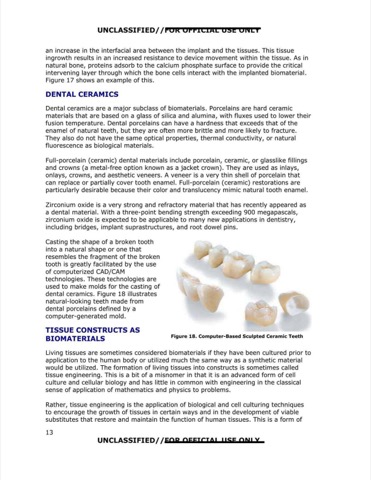
dental ceramics. Figure 18 illustrates
natural-looking teeth made from
dental porcelains defined by a
computer-generated mold.
TISSUE CONSTRUCTS AS
BIOMATERIALS
Figure 18. Computer-Based Sculpted Ceramic Teeth
Living tissues are sometimes considered biomaterials if they have been cultured prior to
application to the human body or utilized much the same way as a synthetic material
would be utilized. The formation of living tissues into constructs is sometimes called
tissue engineering. This is a bit of a misnomer in that it is an advanced form of cell
culture and cellular biology and has little in common with engineering in the classical
sense of application of mathematics and physics to problems.
Rather, tissue engineering is the application of biological and cell culturing techniques
to encourage the growth of tissues in certain ways and in the development of viable
substitutes that restore and maintain the function of human tissues. This is a form of
13
UNCLASSIFIED//EOR OFFICIAL USE ONLY