Text of page 18
UNCLASSIFIED// FOR
At UsE oNLY
composed of long-chain molecules crosslinked to one another to create many small
empty spaces that can absorb water or other liquids like a sponge. Hydrogels can be
extruded into nearly any shape. Figure 14 shows them as small dots.
If the spaces are filled with a drug, the hydrogel can dispense the drug gradually as the
structure biodegrades. Hydrogels are also used for tissue engineering and tissue repair,
where the spaces in the gel might be filled with stem cells, tissue-growth factors, or a
combination of the two.
Hydrogels are cross-linked polymer networks that are insoluble in body fluids but are
able to swell and often have a water content of up to 90 percent. These can be formed
byrosler, cope mer, or typisody mer. With the is corporation of freint a
monomers, gels with wide-ranging chemical and physical properties can be formed. The
gels can be neutral or charged, soft or stiff, strong or brittle. Hydrogels are routinely
used for biomedical and pharmaceutical applications such as drug release, artificial
tendons, wound-healing bioadhesives, artificial kidney membranes, artificial skin, and
contact lenses.
TITANIUM - HIP AND KNEE JOINTS
Titanium-based hip and knee implants are quite successful and are among the most
common orthopedic procedures. When a hip replacement is performed, the arthritic,
damaged hip joint is removed. The ball-and-socket hip joint is then replaced with an
artificial implant.
Hip implants often show no visible
sign of their existence in either
walking gait or functionality. In adults,
they can last a lifetime. Knee implants
are also known to be successful.
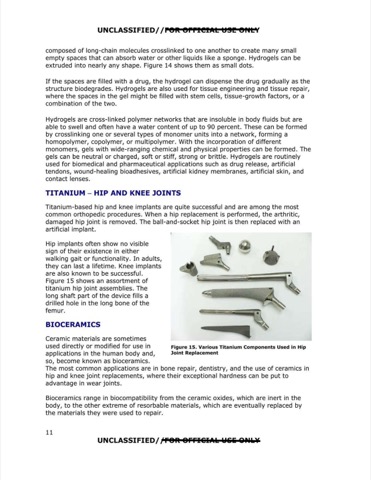
Figure 15 shows an assortment of
titanium hip joint assemblies. The
long shaft part of the device fills a
drilled hole in the long bone of the
femur.
BIOCERAMICS
Ceramic materials are sometimes
used directly or modified for use in
applications in the human body and,
Figure 15. Various Titanium Components Used in Hip
Joint Replacement
so, become known as bioceramics.
The most common applications are in bone repair, dentistry, and the use of ceramics in
hip and knee joint replacements, where their exceptional hardness can be put to
advantage in wear joints.
Bioceramics range in biocompatibility from the ceramic oxides, which are inert in the
body, to the other extreme of resorbable materials, which are eventually replaced by
the materials they were used to repair.
11
UNCLASSIFIED/ /FOR OFFICIAL USE ONLY