DOW-UAP-D119

AAWSAP DIRD, Biomaterials, January 2010, page 17

One page of a U.S. government record released under PURSUE, shown on its own with its text. The record page has the whole document, its catalog details and the scan.

Page
17 of 32
Agency
Department of War
Released
Release 06, September 18, 2026

Text of page 17

UNCLASSIFIED//TOR OF AL USE ONLY tissues. The barrier remains in place only for a week or so during the healing process before biodegrading so no foreign body is left inside of the body. POLYETHYLENE GLYCOL OR POLYETHYLENE OXIDE Polyethylene glycol (PEG) is a widely used material in biomedicine, pharmaceuticals, cosmetics, and agriculture. Its chemical compatibility, water solubility, nontoxicity, biocompatibility, and multiple physical states allow it be used as coatings and in solid form to create surfaces that are very acceptable to biology. Figure 13 shows the marketing of PEG to broad markets that include biodegradable polymers. PLA/PEG Biodegradable Polymers One of PEG's major applications is in the creation of "nonfouling" surfaces when exposed to blood or biological environments. The nonfouling, or cell- and protein-resistant, properties of surfaces containing PEG are due to the material's highly hydrated state. Figure 13. Biodegradable Polymers Based on Copolymers of Polylactic Acid and Polyethylene Glycol PEG is used in drug delivery systems to improve the solubility of drugs and to help stabilize immunogenic or unstable protein drugs. This can enhance the circulation times and stabilities of drugs in the body. HYDROGELS Hydrogels are liquid or semisolid materials that have a strong affinity for water. Poly(hydroxyethyl methacrylic) acid, or poly (HEMA), is one of the most important hydrogels in the biomaterials world because it has many advantages over other hydrogels. These include a water content similar to living tissue, inertness to biological processes, resistance to degradation, permeability to metabolites, and resistance to absorption by the body. Poly(HEMA) can easily be manufactured into many shapes and forms and be easily sterilized. This is Figure 14. Dots of Hydrogel due to its structure, which is 10 UNCLASSIFIED/ TOK OFFICIAL USE ONLY

Machine-read (OCR) from the scan by this archive; it can contain errors. The scan is the record.
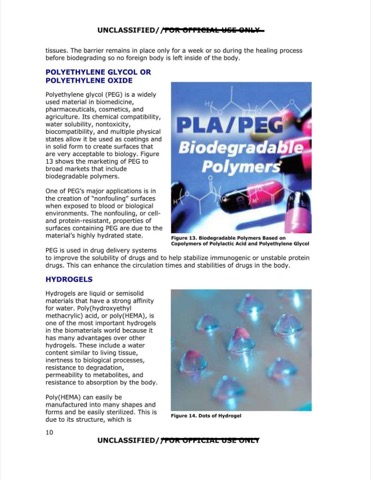
Image from page 17 of DOW-UAP-D119, as released by war.gov
Image from page 17 of the PDF. Open the scan to see the whole page.

Cite this page

U.S. Department of War. "AAWSAP DIRD, Biomaterials, January 2010" (DOW-UAP-D119). PURSUE Release 06, U.S. Department of War, September 18, 2026. https://www.war.gov/medialink/ufo/sept-18/release-06/assets/DOW-UAP-D119_AAWSAP-DIRD-Biomaterials-January-7-2010.pdf. Declassified UAP, page 17, https://declassifieduap.org/r/dow-uap-d119-aawsap-dird-biomaterials-january-2010/p/17. Accessed November 28, 2026.

This address shows page 17 on its own; /r/dow-uap-d119-aawsap-dird-biomaterials-january-2010?page=17 opens the same page in the full reader. Both stay. How to cite.