DOW-UAP-D119

AAWSAP DIRD, Biomaterials, January 2010, page 16

One page of a U.S. government record released under PURSUE, shown on its own with its text. The record page has the whole document, its catalog details and the scan.

Page
16 of 32
Agency
Department of War
Released
Release 06, September 18, 2026

Text of page 16

UNCLASSIFIED/ /FOR UFI AL USE ONLY PLA, or polylactide, is a thermoplastic, ong-chained organic material derived from renewable resources, such as corn starch (in the United States) or sugarcanes (in the rest of the world). PLA has been recognized for more than a century and is of commercial interest primarily because of its biomedical applications. Figure 11 shows the chemical structure of PLA. These materials are popular because they have already been used in many approved medical implant devices and have been shown to be safe, nontoxic, and biocompatible. They have been used in the development of several commercially available medical Figure 11. Structure of Polylactic Acid (a products, including sutures, tissue Biodegradable Polymer) screws and tacks, guided tissue-regeneration membranes for dentistry, internal bone- fixation devices, microspheres for implantable drug delivery systems, and meniscus and cartilage repair systems. These polymers can potentially be used in the design of vascular and urological stents and skin substitutes. This is possible through the manipulation of the polymer characteristics of these materials, such as their three-dimensional architecture, their mechanical and structural integrity, and their biodegradability. The materials can also be used as scaffolds for tissue engineering and for tissue reconstruction. The Clear Choice A medical application of these materials in thin-sheet form is their placement as a thin barrier layer that prevents entry of debris into wounds and as an underlayer to the skin and body tissue. Figure 12 is an artist's conception of a layer of PLA polymer being placed over the heart after open-heart surgery. Protection in case there is a re-operation... Figure 12. Biodegradable PLA as an Antiadhesion Barrier after Open-Heart Surgery The PLA sheet acts as a barrier and spacer to prevent the healing heart wall from growing an attachment to the chest wall and from forming adhesions onto the overlying 9 UNCLASSIFIED/ /EOR OFFICIAL LISE ONLY

Machine-read (OCR) from the scan by this archive; it can contain errors. The scan is the record.
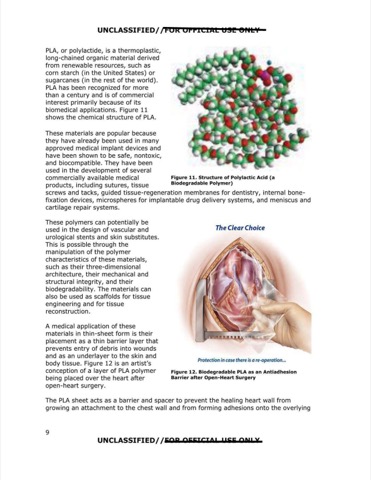
Image from page 16 of DOW-UAP-D119, as released by war.gov
Image from page 16 of the PDF. Open the scan to see the whole page.

Cite this page

U.S. Department of War. "AAWSAP DIRD, Biomaterials, January 2010" (DOW-UAP-D119). PURSUE Release 06, U.S. Department of War, September 18, 2026. https://www.war.gov/medialink/ufo/sept-18/release-06/assets/DOW-UAP-D119_AAWSAP-DIRD-Biomaterials-January-7-2010.pdf. Declassified UAP, page 16, https://declassifieduap.org/r/dow-uap-d119-aawsap-dird-biomaterials-january-2010/p/16. Accessed November 28, 2026.

This address shows page 16 on its own; /r/dow-uap-d119-aawsap-dird-biomaterials-january-2010?page=16 opens the same page in the full reader. Both stay. How to cite.