Text of page 8
UNCLASSIFIED//TOR OFFFErAL USE ONLY
glasses in the true sense of the word, rather than melting abruptly (as crystalline
metals do), they soften and flow over a range of temperatures in a manner akin to
common (oxide) glasses. This creates opportunities for tremendous flexibility in the
processing of metallic glasses.
PROCESSING
Glass-Forming Alloys
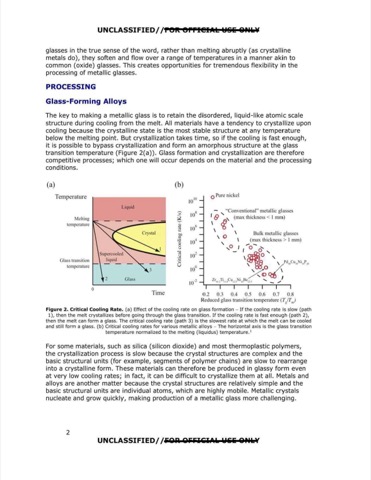
The key to making a metallic glass is to retain the disordered, liquid-like atomic scale
structure during cooling from the melt. All materials have a tendency to crystallize upon
cooling because the crystalline state is the most stable structure at any temperature
below the melting point. But crystallization takes time, so if the cooling is fast enough,
it is possible to bypass crystallization and form an amorphous structure at the glass
transition temperature (Figure 2(a)). Glass formation and crystallization are therefore
competitive processes; which one will occur depends on the material and the processing
conditions.
(a)
(b)
Temperature
o Pure nickel
Liquid
10'
10
Melting
temperature
Crystal
Glass transition
temperature
Supercooled
liquid
2
Critical cooling rate (K/s)
"Conventional" metallie glasses
(max thickness < 1 mm)
Bulk metallic glasses
(max thickness > 1 mm)
Glass
10
10
107
Time
0.2
0.3 0.4 0.5
0.6
0.7
0.8
Reduced glass transition temperature (T/T,)
Figure 2. Critical Cooling Rate. (a) Effect of the cooling rate on glass formation - If the cooling rate is slow (path
1), then the melt crystallizes before going through the glass transition. If the cooling rate is fast enough (path 2),
then the melt can form a glass. The critical cooling rate (path 3) is the slowest rate at which the melt can be cooled
and still form a glass. (b) Critical cooling rates for various metallic alloys - The horizontal axis is the glass transition
temperature normalized to the melting (liquidus) temperature.1
For some materials, such as silica (silicon dioxide) and most thermoplastic polymers,
the crystallization process is slow because the crystal structures are complex and the
basic structural units (for example, segments of polymer chains) are slow to rearrange
into a crystalline form. These materials can therefore be produced in glassy form even
at very low cooling rates; in fact, it can be difficult to crystallize them at all. Metals and
alloys are another matter because the crystal structures are relatively simple and the
basic structural units are individual atoms, which are highly mobile. Metallic crystals
nucleate and grow quickly, making production of a metallic glass more challenging.
2
UNCLASSIFIED//FOR
AL USE ONLY