DOW-UAP-D117

AAWSAP DIRD, Metallic Glasses for Aerospace Applications, December 2009, page 7

One page of a U.S. government record released under PURSUE, shown on its own with its text. The record page has the whole document, its catalog details and the scan.

Page
7 of 30
Agency
Department of War
Released
Release 06, September 18, 2026

Text of page 7

UNCLASSIFIED// FOR OFFE AL USE ONLY Metallic Glasses STRUCTURE The atomic-scale structure of most metals and alloys is crystalline; that is, the atoms are arranged in a highly ordered manner on a lattice that is periodic in three dimensions, as depicted in Figure 1(a). In contrast to this crystalline structure, metallic glasses lack the long-range order of a lattice and are therefore said to be amorphous, as depicted in Figure 1(b). Although the word "amorphous" implies a complete lack of structural order, in fact the atomic structure of metallic glasses is not truly random. Constraints on atomic packing provide strong short-range order; for instance, on average the atoms have a particular number of nearest atomic neighbors at a well- defined distance. But this short-range order persists only over distances of a few atoms; there is no long-range order as there is in a crystalline alloy. In many ways, the atomic-scale structure of metallic glasses more closely resembles the highly disordered structure of a liquid than the structure of a crystalline alloy. (a (b Crystalline Amorphous (glass) Figure 1. Amorphous Versus Crystalline Structure. Schematic atomic-scale structure of crystalline (a) and amorphous (b) metals. In a crystalline structure, order persists over long distances (many atomic dimensions). In a glass, there is short range order but no long-range order. A corollary of this difference in structure is that the nature of structural defects is quite different between crystalline and amorphous alloys. Crystalline alloys, for example, have extended linear defects in the crystal structure, called dislocations, that are (in large part) responsible for determining mechanical behavior. The lack of crystalline order precludes the existence of dislocations in metallic glasses, but other sorts of defects can be present and may influence properties and behavior. From an applications point of view, the amorphous structure of metallic glasses has two principal implications. First, the mechanical properties of amorphous alloys are significantly different from those of their crystalline counterparts; some of these differences are advantageous, but others are not. Second, because metallic glasses are 1 UNCLASSIFIED//FOR OFFL AL USE ONLY

Machine-read (OCR) from the scan by this archive; it can contain errors. The scan is the record.
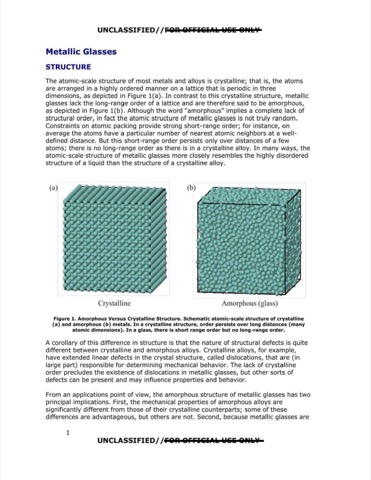
Image from page 7 of DOW-UAP-D117, as released by war.gov
Image from page 7 of the PDF. Open the scan to see the whole page.

Cite this page

U.S. Department of War. "AAWSAP DIRD, Metallic Glasses for Aerospace Applications, December 2009" (DOW-UAP-D117). PURSUE Release 06, U.S. Department of War, September 18, 2026. https://www.war.gov/medialink/ufo/sept-18/release-06/assets/DOW-UAP-D117_AAWSAP-DIRD-Metallic-Glasses-for-Aerospace-Applications-December-14-2009.pdf. Declassified UAP, page 7, https://declassifieduap.org/r/dow-uap-d117-aawsap-dird-metallic-glasses-for-aerospace-applications-december-2009/p/7. Accessed November 28, 2026.

This address shows page 7 on its own; /r/dow-uap-d117-aawsap-dird-metallic-glasses-for-aerospace-applications-december-2009?page=7 opens the same page in the full reader. Both stay. How to cite.