Text of page 9
UNCLASSIFIED//FOR 0I
AL USE ONLY
One way to quantify the ability of a metallic alloy to be produced in glassy form is
through the critical cooling rate-the slowest rate at which a metallic liquid may be
cooled and still produce a fully amorphous structure, as shown in Figure 2(a). The
critical cooling rate for a variety of metallic glass-forming alloys is shown in Figure 2(b).
Early metallic glasses (discovered in the 1960s and 1970s) were binary alloys with
critical cooling rates typically on the order of 104 to 107 K/s. Achieving such high
cooling rates requires specialized techniques (such as melt spinning) and limits the
maximum thickness of the metallic glass to < 100 pm because of the need to rapidly
extract heat from the melt. As a result, these early metallic glasses could be produced
in only a limited range of forms, including ribbons, foils, wires, and powders.
Extensive research efforts in alloy design over the past two decades have resulted in
the development of multi-component alloys with much lower critical cooling rates (0.1
K/s or even lower). This has enabled the production of metallic glass specimens in
larger sizes-in some cases exceeding 1-cm section thickness. Common practice in the
field is to refer to any alloy capable of being cast into a section at least 1-mm thick as a
"bulk" metallic glass. These alloys may be cast or molded into forms suitable for
structural applications.
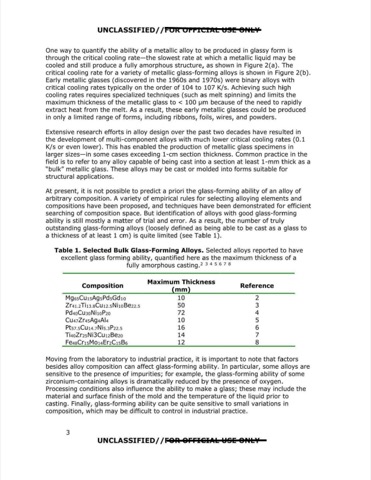
At present, it is not possible to predict a priori the glass-forming ability of an alloy of
arbitrary composition. A variety of empirical rules for selecting alloying elements and
compositions have been proposed, and techniques have been demonstrated for efficient
searching of composition space. But identification of alloys with good glass-forming
ability is still mostly a matter of trial and error. As a result, the number of truly
outstanding glass-forming alloys (loosely defined as being able to be cast as a glass to
a thickness of at least 1 cm) is quite limited (see Table 1).
Table 1. Selected Bulk Glass-Forming Alloys. Selected alloys reported to have
excellent glass forming ability, quantified here as the maximum thickness of a
fully amorphous casting. 2 3 4 5 6 7 8
Composition
Mg65C15AgsPdsGd10
Zr41.2T/13.8CU12.5Ni10Be22.5
Pd40CuoNi10P20
Cu47Zr45AgA|4
Pt57.5CU14.7Nis.3P22.5
Ti40Zr25Ni3Cu12Be20
Fe48CrisMo14Er2C15B6
Maximum Thickness
(mm)
10
50
72
10
16
14
12
Reference
8
Moving from the laboratory to industrial practice, it is important to note that factors
besides alloy composition can affect glass-forming ability. In particular, some alloys are
sensitive to the presence of impurities; for example, the glass-forming ability of some
zirconium-containing alloys is dramatically reduced by the presence of oxygen.
Processing conditions also influence the ability to make a glass; these may include the
material and surface finish of the mold and the temperature of the liquid prior to
casting. Finally, glass-forming ability can be quite sensitive to small variations in
composition, which may be difficult to control in industrial practice.
3
UNCLASSIFIED// FOR OFFICIAL USE ONLY