DOW-UAP-D167

Project Capella, December 2008, page 13

One page of a U.S. government record released under PURSUE, shown on its own with its text. The record page has the whole document, its catalog details and the scan.

Page
13 of 42
Agency
Department of War
Released
Release 07, October 23, 2026

Archive note war.gov's data file spells the location "San Fransisco"; this archive corrects the spelling. See all corrections

Text of page 13

1843(a)(2) Type I, which was further divided into three subgroups, gathered all the "landing" reports that 1843(a)(2) would later call "close encounters." It may be hard for the modern reader to realize that until the late Sixties, American ufology did not admit that such reports existed 1843(a)(2) Among the major civilian organizations, only APRO, headed up byl recognized their significance. The Air Force's Project Blue Book automatically sent landing reports into the psychological file. 1843(a)(2) Type II reports were observations of the "cloud cigars" so prevalent in Europe in 1954, and whose apparent role in the development of major waves had been pointed out by 1843(a)(2) (+). Such reports became rare in the following years, and there is no longer a justification for this category. Type III reports involved objects that exhibited a discontinuity in their trajectory; either they stopped and hovered, or they came towards the ground with a falling leaf motion before resuming their flight, or they performed some other maneuver that identified a specific point in space and time. This was important for us at the time because we were compiling a catalogue with longitudes and latitudes, recorded with as much precision as possible. Type IV, by contrast, gathered all cases of objects in uninterrupted flight. This classification served its purpose for many years. It enabled us to uncover specific time and space patterns for various types of behavior, notably the "law of the times" for landing reports. (1843(a)(2) classification 1843(a)(2) In 1972, on the basis of the work we had done together since the mid-sixties, built upon my earlier classification when he proposed (*) to divide all reports into two groups: the short- range sightings which corresponded to my "Type l" and which he called Close Encounters (1843(a)(2) AAP Person Appendix A page 2

Machine-read (OCR) from the scan by this archive; it can contain errors. The scan is the record.
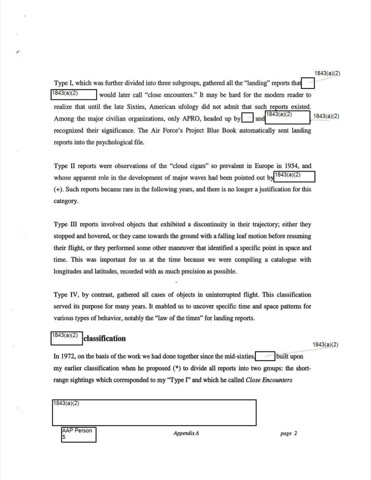
Image from page 13 of DOW-UAP-D167, as released by war.gov
Image from page 13 of the PDF. Open the scan to see the whole page.

Cite this page

U.S. Department of War. "Project Capella, December 2008" (DOW-UAP-D167). PURSUE Release 07, U.S. Department of War, October 23, 2026. https://www.war.gov/medialink/ufo/release-07/documents/DOW-UAP-D167-Project_Capella-December-2008.pdf. Declassified UAP, page 13, https://declassifieduap.org/r/dow-uap-d167-project-capella-december-2008/p/13. Accessed November 28, 2026.

This address shows page 13 on its own; /r/dow-uap-d167-project-capella-december-2008?page=13 opens the same page in the full reader. Both stay. How to cite.