DOW-UAP-D167

Project Capella, December 2008, page 12

One page of a U.S. government record released under PURSUE, shown on its own with its text. The record page has the whole document, its catalog details and the scan.

Page
12 of 42
Agency
Department of War
Released
Release 07, October 23, 2026

Archive note war.gov's data file spells the location "San Fransisco"; this archive corrects the spelling. See all corrections

Text of page 12

Appendix A A System of Classification and Reliability Indicators for the Analysis of the Behavior of Unidentified Aerial Phenomena AAP Person 5 When faced with hundreds or even thousands of reports of unusual aerial phenomena, no serious researcher can undertake any study or hazard any hypothesis before analyzing the - patterns buried in the reports. These patterns only reveal themselves when the witnesses' accounts are classified into major categories whose prevalence and recurrence can then be computed. This is a time-consuming task that demands a great deal of rigor, which explains why so few research organizations have done it consistently. In our own work, we have used such classification systems for many years, in the context of very different data sets. We have learned from early mistakes, and this effort has led us to propose the current scheme based on the reported behavior of the phenomenon under observation. The purpose of this paper is to clarify the system and its practical use. Background Any classification system for anomalous reports needs to start from the observed behavior of the phenomenon rather than any subjective feature special to the observer. At the same time, the classification system must be able to support the testing of hypotheses by researchers coming from "skeptical" as well as "proponent" positions with respect to popular interpretations of the phenomena in question. And it must not presuppose any particular theory. To my knowledge, the first classification system of this type that was applied to unidentified aerial phenomena grew out of my work in 1961 and 1962 with 1843(a)(2) and (1843(a)(2) 1843(a) (2) in Paris. I proposed to separate the massive collections of French sightings - notably those from the 1954 wave - into four major categories. Briefly summarized, they encompassed the following: AAP Person Appendix A page 1

Machine-read (OCR) from the scan by this archive; it can contain errors. The scan is the record.
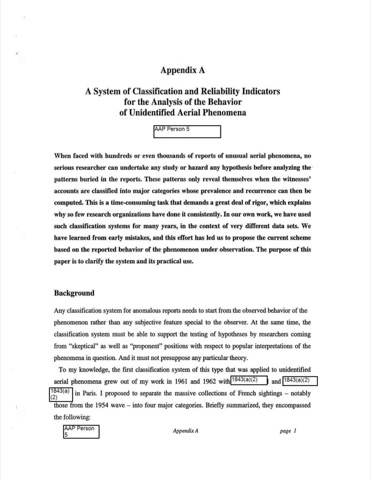
Image from page 12 of DOW-UAP-D167, as released by war.gov
Image from page 12 of the PDF. Open the scan to see the whole page.

Cite this page

U.S. Department of War. "Project Capella, December 2008" (DOW-UAP-D167). PURSUE Release 07, U.S. Department of War, October 23, 2026. https://www.war.gov/medialink/ufo/release-07/documents/DOW-UAP-D167-Project_Capella-December-2008.pdf. Declassified UAP, page 12, https://declassifieduap.org/r/dow-uap-d167-project-capella-december-2008/p/12. Accessed November 28, 2026.

This address shows page 12 on its own; /r/dow-uap-d167-project-capella-december-2008?page=12 opens the same page in the full reader. Both stay. How to cite.