Text of page 8
atomic mixtures of deuterium and palladium work best, (c) it is more productive at higher temperatures; (d)
there are unknown triggering effects to get the reactions started; (e) the ddHe reaction noted above is the main
source of energy; (f) sometimes neutron emission is observed; (g) calorimetric studies have left no doubt that
ase excess energy results are valid. Nevertheless, the study of cold fusion research is still not an accepted
uational priority.
In spite of overwhelming evidence for the reality of the phenomena as reflected in the maverick
publication Infinite Energy, and annual meetings of the international Conference on Cold Fusion (ICCF),
theories to explain the data have slowly emerged. One idea that seems to survive is that in the experiments
involving solid samples that photon exchange (high frequency acoustic vibration) are responsible for
stimulating the nuclear reactions.'
innovative colleague 1843(a)(2)
Another theoretic approach was taken by fortner MeDonell Douglas ski and 18431a)e1 and developed
who interacted with 1843(a)(2)
and his
some basic principles that would be aimed at replicating the conditions of the successful 1843(a)(2)
experiment that apparently had high temperatures and internal pressures involved. Taking the position that in
order for cold fusion to be a successful business venture, excess energies of Kw/cc will be required, and these
will never occur unless we go to high temperatures and pressures. Therefore, by studying the "boil-dry" case of
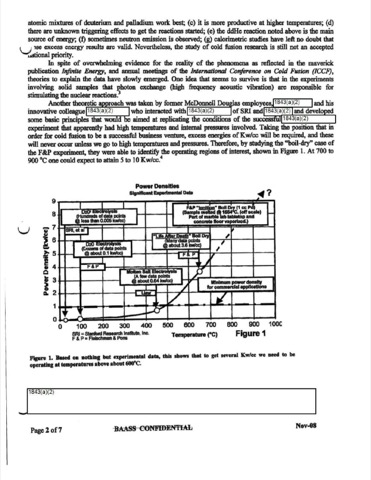
the F&P experiment, they were able to identify the operating regions of interest, shown in Figure 1. At 700 to
900 °C one could expect to attain 5 to 10 Kw/cc.*
8
7
D20r Electrolysis
(Hundreds of data points
@ less than 0.005 kw/ce)
SRi, et al
D20 Eluctrolysis
(Cozens of deta points
© about 0,1 kwi/oc)
F&P
Power Densities
Significant Experimental Data
-aP "lanition" Ball Dry (1 cc Pd
Sample melted (@ 1554°C. (off scale
Part of marbte lab tabletop and
concrete floor vaporized.)
"Lila Altor Denti)" Boll Dry
Many data point:
@ about 3.6 kw/ce)
FIP
?
Power Density (kwice)
Molten Salt Elecirolysis
A few data point
* about 0.64 kw/oc
Minimum power density
for commercial applications
1
o Lo
-
100
200
300
400
500
600
700
Temperature (*C)
800
900 100C
Figure 1
Figure 1. Based on nothing but experimental data, this shows that to get several Kw/ee we need to be
operating at temperatures above about 600°C.
(1843(a)(2)
Page 2 of 7
BAASS CONFIDENTIAL
Nov-08