DOW-UAP-D153

AAWSAP DIRD, Quantum Tomography of Negative Energy States in the Vacuum, January 2011, page 14

One page of a U.S. government record released under PURSUE, shown on its own with its text. The record page has the whole document, its catalog details and the scan.

Page
14 of 51
Agency
Department of War
Released
Release 06, September 18, 2026

Text of page 14

UNCLASSIFIED//EOR OFFH AL USE ONLY Morris and Thorne [8] and Caves [45] point out that if one squeezes the vacuum, i.e., if one puts vacuum rather than laser light into the input port of a squeezing device, then one gets at the output an electromagnetic field with weaker fluctuations and thus less energy density than the vacuum at locations where cos' [w(t-z/c)]=1 and sin' 0(t-z/c) << 1; but with greater fluctuations and thus greater energy density than the vacuum at locations where cos' [w(t-z/c)] << 1 and sin' 0(t-z/c) =1. Since the vacuum is defined to have vanishing energy density, any region with less energy density than the vacuum actually has a negative (renormalized) expectation value for the energy density. Therefore, a squeezed vacuum state consists of a traveling electromagnetic wave that oscillates back and forth between negative energy density and positive energy density, but has positive time-averaged energy density. In quantum optics the squeezed state is generated by the unitary squeezing operator: § = exp (5) where & is a real number that parameterizes the deviation of the variances Aâ and Aê from their vacuum values and is called the squeezing parameter. From Eq. (5) we obtain the squeezed vacuum state |p) = $(5)[0). The squeezing operator §(E) is simply an evolution operator that describes the result of the nonlinear squeezing interaction Hamiltonian A = x b°ổ? - bât). The squeezing parameter § contains the product of the amplitude b, the coupling constant x, and the interaction time. But this is not the entire story. Since we will be dealing with high-quality lasers in what follows, we also need to know about another important quantum optics operator that acts on coherent states. We introduce the unitary displacement operator Đ(a) = exp (aấ -a'ã). Ê(a) displaces the amplitude by the complex number a according to * (a)âÔ(a) =â+a. To show why (a) has anything to do with coherent states, we apply a negative displacement to (a). From the basic property of (a), we see that âD(-a)|a) = Đ(-a)Đ* (-a)âD(-a)|a) = Đ(-a)(â-a) a) =0. (6) Equation (6) equals zero because of the definition Eq. (3) of coherent states. This result implies that (-a)|a) =|0), which is the vacuum state. Therefore, coherent states (a) are displaced vacua |a) = (a)[0). This does not mean that coherent states 10 UNCLASSIFIED//TOR OFFICIAL USE ONLY

Machine-read (OCR) from the scan by this archive; it can contain errors. The scan is the record.
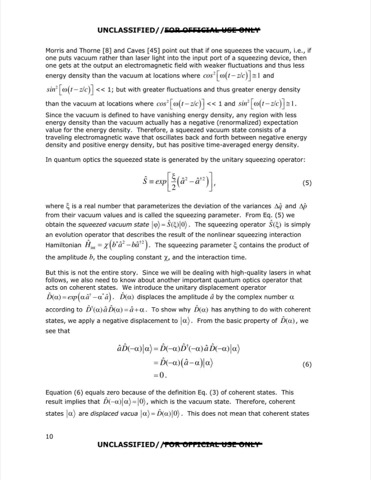
Image from page 14 of DOW-UAP-D153, as released by war.gov
Image from page 14 of the PDF. Open the scan to see the whole page.

Cite this page

U.S. Department of War. "AAWSAP DIRD, Quantum Tomography of Negative Energy States in the Vacuum, January 2011" (DOW-UAP-D153). PURSUE Release 06, U.S. Department of War, September 18, 2026. https://www.war.gov/medialink/ufo/sept-18/release-06/assets/DOW-UAP-D153_AAWSAP-DIRD-Quantum-Tomography-of-Negative-Energy-States-in-the-Vacuum-January-11-2011.pdf. Declassified UAP, page 14, https://declassifieduap.org/r/dow-uap-d153-aawsap-dird-quantum-tomography-of-negative-energy-states-in-the-vacuum-january-2011/p/14. Accessed November 28, 2026.

This address shows page 14 on its own; /r/dow-uap-d153-aawsap-dird-quantum-tomography-of-negative-energy-states-in-the-vacuum-january-2011?page=14 opens the same page in the full reader. Both stay. How to cite.