Text of page 13
UNCLASSIFIED//FeR eFFreIAL USE ONLY
cos @(t-z/c) part of the beam and into the sin (t- z/c)| part [18, 40-44].55 The
observable that gets squeezed will have its fluctuations reduced below the vacuum PF.
The act of squeezing transforms the phase space circular noise profile characteristic of
the vacuum into an ellipse, whose semimajor and semiminor axes are given by unequal
quadrature uncertainties (of the quantized electromagnetic oscillator operators). This
applies to coherent states in general, and the usual vacuum is also a coherent state
with eigenvalue zero. As this ellipse rotates about the origin with angular frequency co,
these unequal quadrature uncertainties manifest themselves in the electromagnetic
field oscillator energy by periodic occurrences, which are separated by one quarter
cycle, of both smaller and larger fluctuations compared to the unsqueezed vacuum.
We digress momentarily by noting that coherent states, also called Glauber states, are
the eigenstates of the annihilation operator â:
âla) = ala),
(3)
which have well-defined amplitudes la and phases arg(a) (recall the discussion in Sect.
IIB-1). They are called coherent states because light fields in these states are perfectly
coherent, and high-quality lasers generate such fields. This is an important reason why
high-quality laser light is an excellent tool for experimental quantum optics. Coherent
states come as close as quantum mechanics allows to wave-like states of the
electromagnetic oscillator. Because the wave aspects of light are commonly regarded
as classical, coherent states are often called classical states. Furthermore, fields in
statistical mixtures of coherent states (such as thermal fields) are classical as well,
whereas any state that cannot be understood as an ensemble of coherent states is
called nonclassical. The experimental generation and application of nonclassical light
fields is the main subject of this report. Despite much recent progress, producing
nonclassical states of light is still extremely challenging because they are easily
destroyed (reduced to classical) by any kind of losses. Furthermore, it turns out that
the vacuum is a coherent state as well because it satisfies Eq. (3) for a = 0. In other
words, the vacuum is a zero-amplitude coherent state. With a little algebra we see
directly from Eq. (3) that the mean (i.e., quantum expectation value of the) energy of a
coherent state with unit frequency is
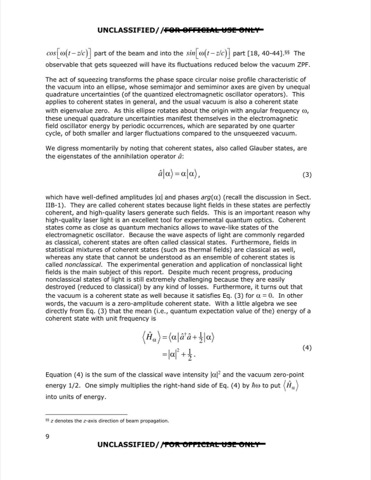
(4)
Equation (4) is the sum of the classical wave intensity lal and the vacuum zero-point
energy 1/2. One simply multiplies the right-hand side of Eq. (4) by ho to put Ha)
into units of energy.
85 z denotes the z-axis direction of beam propagation.
9
UNCLASSIFIED/ /FOR OFFICIAL USE ONLY