DOW-UAP-D151

AAWSAP DIRD, Cognitive Limits on Simultaneous Control of Multiple Unmanned Spacecraft, December 2010, page 19

One page of a U.S. government record released under PURSUE, shown on its own with its text. The record page has the whole document, its catalog details and the scan.

Page
19 of 31
Agency
Department of War
Released
Release 06, September 18, 2026

Text of page 19

UNCLASSIFIED/ /FOR OFFI AL USE ONLY The more recent Collet study recorded 5 ANS variables from 25 participants during real ATC operations. The population, mean age of 44, included only fully qualified operators, who were monitored for one hour during TRACON duty at Saint Exupéry International Airport (Lyon, France). Correlation analyses were performed with the number of aircraft the operator was currently controlling. No adjustment was made for task complexity; however, data were acquired between 6 and 9 PM local time to collect medium and high workload data. Each participant handled between 1 and 10 aircraft during the study. The results of the correlation analysis are shown in Table 2. The authors conclude that changing the number of aircraft for professional ATCs produced correlations in physiological measures for SC, SBF, and IHR. 31 Table 2. Correlations among Physiological Variables in a study of air traffic controller workload modulation with variable number of aircraft. NA: number of aircraft; TLX: NASA self-report workload metric; Std SC: normalized skin conductance; Std SP: normalized skin potential; Std SBF: normalized capillary blood flow measured through the skin; Std ST: normalized skin temperature; Std IHR: normalized instantaneous heart rate. Bold values show significant correlation. SC, SBF, and IHR show significant correlation with changes in NA. Normalizations (standardizations) were performed against baseline data per subject to decrease inter-subject noise. 31 NA TLX Std SC Std SP Std SBF Std ST Std IHR NA 1 .98 p<.001 .93 p=.002 .77 NS -.97 p<.0001 -.79 NS .98 p<.0001 TLX Std SC Std SP Std SBF Std ST 1 .89 p=.008 .67 NS -.94 p=.001 -.80 NS .95 p<.0001 1 .91 1 p=.005 --87 -.75 P=.02 NS -.62 - 43 NS NS .97 .85 p<.0001 p=.03 1 .82 NS --93 p=.002 1 -.88 p=.005 Adaptive automation (AA) is the rebalancing of workload between the computer and human. Low workload levels can be supplemented with usually routine tasks that will keep the operator attentive, while providing the subject with additional mission information. This "extra information" may not be critical, but it will keep the subject from disengaging from the overall task. The goal of AA is to maintain peak performance of the system, in the A1 to A3 regions. Kaber studied AA in terms of a simulated ATC task in 2005. Forty non-professional participants were monitored for primary and a probe secondary task performances. Results showed that primary task performance was greatest when AA was added to the system. 34 14 UNCLASSIFIED/ /FOR OFFICIAL USE ONLY

Machine-read (OCR) from the scan by this archive; it can contain errors. The scan is the record.
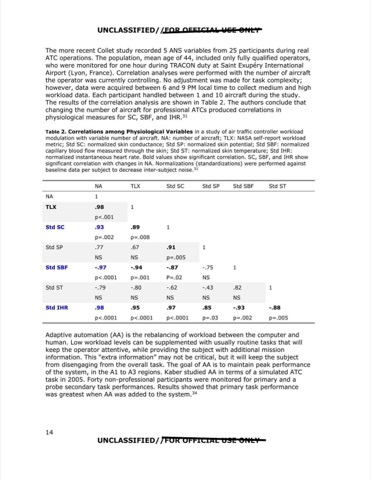
Image from page 19 of DOW-UAP-D151, as released by war.gov
Image from page 19 of the PDF. Open the scan to see the whole page.

Cite this page

U.S. Department of War. "AAWSAP DIRD, Cognitive Limits on Simultaneous Control of Multiple Unmanned Spacecraft, December 2010" (DOW-UAP-D151). PURSUE Release 06, U.S. Department of War, September 18, 2026. https://www.war.gov/medialink/ufo/sept-18/release-06/assets/DOW-UAP-D151_AAWSAP-DIRD-Cognitive-Limits-on-Simultaneous-Control-of-Multiple-Unmanned-Spacecraft-December-15-2010.pdf. Declassified UAP, page 19, https://declassifieduap.org/r/dow-uap-d151-aawsap-dird-cognitive-limits-on-simultaneous-control-of-multiple-unmanned-spacecraft-december-2010/p/19. Accessed November 28, 2026.

This address shows page 19 on its own; /r/dow-uap-d151-aawsap-dird-cognitive-limits-on-simultaneous-control-of-multiple-unmanned-spacecraft-december-2010?page=19 opens the same page in the full reader. Both stay. How to cite.