DOW-UAP-D151

AAWSAP DIRD, Cognitive Limits on Simultaneous Control of Multiple Unmanned Spacecraft, December 2010, page 18

One page of a U.S. government record released under PURSUE, shown on its own with its text. The record page has the whole document, its catalog details and the scan.

Page
18 of 31
Agency
Department of War
Released
Release 06, September 18, 2026

Text of page 18

UNCLASSIFIED/ /FOR eFFICH AL ust ontr crash any planes in any of the scenarios - this required approximately 6 hours of practice per participant before the experiment was conducted. Only one of the eight controllers in the Brookings study rated the overload condition as a loss of situational awareness. The results compared the TLX, primary task performance, and physiological measures to low, medium, and high workload conditions, as well as the max or overload condition. Primary task performance is represented in Figure 4 (this chart was recreated visually from the source chart to accurately represent all trends), showing a trending effect for complexity but not volume. Additional results showed that changes in task difficulty (volume or complexity) produced changes in TLX, eye blink rate, respiration rate, and the EEG power spectra. The EEG power spectra were different for changes in volume versus changes in complexity. There were no observed significant correlations with heart rate or heart rate variability. The authors conclude that psychophysiological data can be used to accurately measure workload in real-time, an observation they note confirms earlier work on F4 crew members performing flight tasks of modulated complexity, 32 The Brookings data was reanalyzed by Wilson in 2003 using an artificial neural network approach as well as a stepwise discriminate analysis to classify a physiological state as either operational or overloaded. Wilson successfully classified the overload condition consistently in more than 98% of the cases. The authors admit an issue with psychophysiological variation (day-to-day) that would need to be normalized and further research is required. 33 100 80 • Volume • Complexity • Overload Percent Performance Points 60 40 20 0 Low Medium High Max Workload Figure 4. Representation of Performance Results from Brookings Study. 30 Shown are the three scenarios with modulation of traffic volume, complexity, and the overload condition. Note that the Low workload entry for the volume modulation performance (6 planes) was already 80% and this was similar to the 12-plane medium complexity performance. Only the low complexity, 12-plane scenario showed near 100% primary task performance. 13 UNCLASSIFIED/ /FOR OFFICIAL USE ONLY

Machine-read (OCR) from the scan by this archive; it can contain errors. The scan is the record.
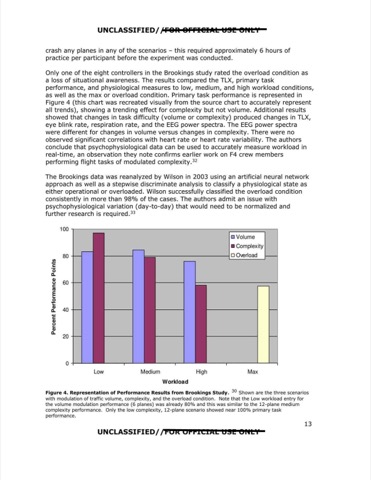
Image from page 18 of DOW-UAP-D151, as released by war.gov
Image from page 18 of the PDF. Open the scan to see the whole page.

Cite this page

U.S. Department of War. "AAWSAP DIRD, Cognitive Limits on Simultaneous Control of Multiple Unmanned Spacecraft, December 2010" (DOW-UAP-D151). PURSUE Release 06, U.S. Department of War, September 18, 2026. https://www.war.gov/medialink/ufo/sept-18/release-06/assets/DOW-UAP-D151_AAWSAP-DIRD-Cognitive-Limits-on-Simultaneous-Control-of-Multiple-Unmanned-Spacecraft-December-15-2010.pdf. Declassified UAP, page 18, https://declassifieduap.org/r/dow-uap-d151-aawsap-dird-cognitive-limits-on-simultaneous-control-of-multiple-unmanned-spacecraft-december-2010/p/18. Accessed November 28, 2026.

This address shows page 18 on its own; /r/dow-uap-d151-aawsap-dird-cognitive-limits-on-simultaneous-control-of-multiple-unmanned-spacecraft-december-2010?page=18 opens the same page in the full reader. Both stay. How to cite.