Text of page 33
UNCLASSIFIED//EAR OFFICIAL USE ONLY
constant concentration around the crystal can easily be realized by a constant flow. This
ground-breaking work in DNA synthesis technology has opened the door for several
applications in genetic engineering and lab on a chip technology (107)(108)(109).
This kind of controlled self-assembly will drastically improve the size and yield of errorless
nano structure. It is also possible to produce desired nano structures on a patterned
template in the reaction chamber for various applications.
Glass plate
Oll rame
Temperature sensor
„Microfluidic devices
(3 sets)
Heater
Oil
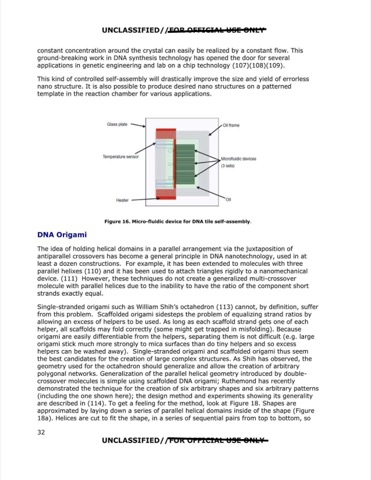
Figure 16. Micro-fluidic device for DNA tile self-assembly.
DNA Origami
The idea of holding helical domains in a parallel arrangement via the juxtaposition of
antiparallel crossovers has become a general principle in DNA nanotechnology, used in at
least a dozen constructions. For example, it has been extended to molecules with three
parallel helixes (110) and it has been used to attach triangles rigidly to a nanomechanical
device. (111) However, these techniques do not create a generalized multi-crossover
molecule with parallel helices due to the inability to have the ratio of the component short
strands exactly equal.
Single-stranded origami such as William Shih's octahedron (113) cannot, by definition, suffer
from this problem. Scaffolded origami sidesteps the problem of equalizing strand ratios by
allowing an excess of helpers to be used. As long as each scaffold strand gets one of each
helper, all scaffolds may fold correctly (some might get trapped in misfolding). Because
origami are easily differentiable from the helpers, separating them is not difficult (e.g. large
origami stick much more strongly to mica surfaces than do tiny helpers and so excess
helpers can be washed away). Single-stranded origami and scaffolded origami thus seem
the best candidates for the creation of large complex structures. As Shih has observed, the
geometry used for the octahedron should generalize and allow the creation of arbitrary
polygonal networks. Generalization of the parallel helical geometry introduced by double-
crossover molecules is simple using scaffolded DNA origami; Ruthemond has recently
demonstrated the technique for the creation of six arbitrary shapes and six arbitrary patterns
(including the one shown here); the design method and experiments showing its generality
are described in (114). To get a feeling for the method, look at Figure 18. Shapes are
approximated by laying down a series of parallel helical domains inside of the shape (Figure
18a). Helices are cut to fit the shape, in a series of sequential pairs from top to bottom, so
32
UNCLASSIFIED / /FOR OF
TAL USE ONLY