DOW-UAP-D150

AAWSAP DIRD, Quantum Computing and Utilizing Organic Molecules in Automation Technology, December 2010, page 32

One page of a U.S. government record released under PURSUE, shown on its own with its text. The record page has the whole document, its catalog details and the scan.

Page
32 of 54
Agency
Department of War
Released
Release 06, September 18, 2026

Text of page 32

UNCLASSIFIED//FO (a) Mismatched (b) Facet 1000000 (e) Random assembly Figure 15. Three Types of Error in DNA Tile Self-assembly (a) Growth error (b) Facet error (c) Nucleation error. Red lines indicate the mismatched sides. Self-assembly with DNA-based Microfluidic Devices Thus far we have explored DNA computing through methods based on linear DNA molecule hybridizations (100) and "DNA tiles" with four "sticky ends"(101). While it has been proven experimentally that DNA tiles have much stronger computational power compared to linear DNA strands (102)(103), the suppression of assembly errors is the central problem of the DNA-tile-based nanotechnology. Even though several error reduction methods have been proposed thus far, many of them only consider the design of DNA tile sets. (104) Traditionally, the result is a complicated tile set and these approaches are rarely implemented. To overcome these restraints, researchers in Tokyo devised a microfluidic device specially designed for DNA tile assembly (105). Traditional DNA Tile assembly methods require that all the DNA tiles are mixed in a single test tube, annealed for self-assembly, and then the mixture is dropped on a mica surface for AFM observation. Since all kinds of tiles are assembled in one pot, DNA tile sets must be very carefully designed such that each sticky end has an appropriate bonding specificity and strength to obtain desired structure. In practice, it is very difficult to keep concentrations of each monomer tile in one-pot self-assembly. Additionally, the assembly process is strongly affected by the concentration of the DNA tile and the temperature of the water solution. With the microfluidic DNA tile self-assembler, a series of stepwise assembly processes are incorporated into construction of the tile lattice. In the microfluidic device, pre-assembled DNA lattices are anchored on the microfluidic channel to initiate tile growth through the following steps: 1) Single-strand DNAs are immobilized on the surface of a reaction chamber. This provides scaffolds to initiate the self-assembly process, while anchoring the assembled structure against the flow. 2) Monomer DNA tiles are supplied by flow in the microchannel. A 31 UNCLASSIFIED / /EOR OFFICIAL USE ONLY

Machine-read (OCR) from the scan by this archive; it can contain errors. The scan is the record.
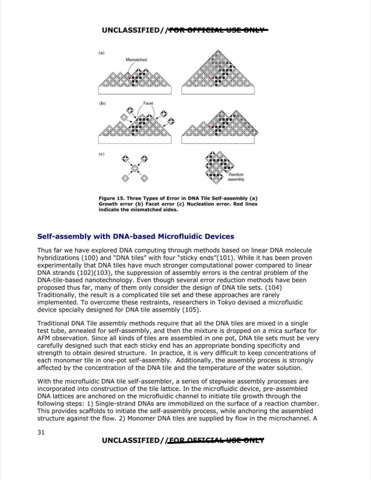
Image from page 32 of DOW-UAP-D150, as released by war.gov
Image from page 32 of the PDF. Open the scan to see the whole page.

Cite this page

U.S. Department of War. "AAWSAP DIRD, Quantum Computing and Utilizing Organic Molecules in Automation Technology, December 2010" (DOW-UAP-D150). PURSUE Release 06, U.S. Department of War, September 18, 2026. https://www.war.gov/medialink/ufo/sept-18/release-06/assets/DOW-UAP-D150_AAWSAP-DIRD-Quantum-Computing-and-Utilizing-Organic-Molecules-in-Automation-Technology-December-10-2010.pdf. Declassified UAP, page 32, https://declassifieduap.org/r/dow-uap-d150-aawsap-dird-quantum-computing-and-utilizing-organic-molecules-in-automation-technology-december-2010/p/32. Accessed November 28, 2026.

This address shows page 32 on its own; /r/dow-uap-d150-aawsap-dird-quantum-computing-and-utilizing-organic-molecules-in-automation-technology-december-2010?page=32 opens the same page in the full reader. Both stay. How to cite.