DOW-UAP-D150

AAWSAP DIRD, Quantum Computing and Utilizing Organic Molecules in Automation Technology, December 2010, page 16

One page of a U.S. government record released under PURSUE, shown on its own with its text. The record page has the whole document, its catalog details and the scan.

Page
16 of 54
Agency
Department of War
Released
Release 06, September 18, 2026

Text of page 16

UNCLASSIFIED//FOR OFFICIAL USE ONLY Quantum Dots in Graphene Nanoribbons Graphene ribbons are one dimensional stripes of graphene. They can be considered as unfolded carbon nanotubes. Graphene ribbons were proposed by Nakada et al in 1996 (52). Nakada used the same single orbital tight-binding model that successfully portrays two- dimensional graphene as a semimetal; graphene ribbons are either metallic or semiconducting depending on their crystallographic orientation and width. More realistic calculations using the Hubbard model in a mean field approximation and density functional calculations show that zigzag ribbons are insulating due to the magnetization of their edges with opposite spin orientation in each edge. It has been found that this anti-ferromagnetic insulator phase has a hidden underlying ferroelectric order that can be described as excitonic insulator whose order parameter is the spin-resolved dipole operator, the analog of the spin current operator (53). Long (g1 um) graphene nanoconstrictions display gapped behavior: conduction is suppressed by several orders of magnitude for a wide range of gate voltages around the Dirac point, and for tens of millivolts of source-drain bias (54) (55). Barrier2 Barrieri Gate Figure 2. Quantum dot in graphene nanoribbon. A ribbon of graphene with semi-conducting armchair boundaries is schematically shown. Two barrier gates (blue) define the rectangular size of the quantum dot (with width W and length L). A back gate (red) allows one to shift the energy levels in the dot. Two or more quantum dots of this type can be easily put in series in a single nanoribbon. 15 UNCLASSIFIED//TOR OFFICIAL USE ONLY

Machine-read (OCR) from the scan by this archive; it can contain errors. The scan is the record.
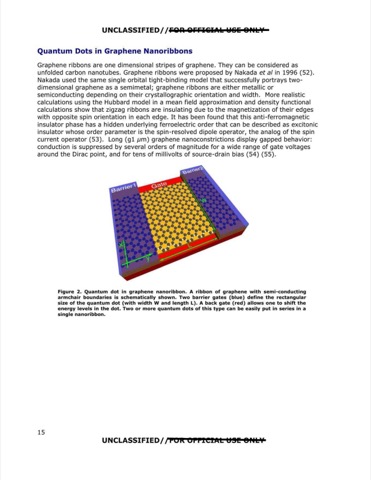
Image from page 16 of DOW-UAP-D150, as released by war.gov
Image from page 16 of the PDF. Open the scan to see the whole page.

Cite this page

U.S. Department of War. "AAWSAP DIRD, Quantum Computing and Utilizing Organic Molecules in Automation Technology, December 2010" (DOW-UAP-D150). PURSUE Release 06, U.S. Department of War, September 18, 2026. https://www.war.gov/medialink/ufo/sept-18/release-06/assets/DOW-UAP-D150_AAWSAP-DIRD-Quantum-Computing-and-Utilizing-Organic-Molecules-in-Automation-Technology-December-10-2010.pdf. Declassified UAP, page 16, https://declassifieduap.org/r/dow-uap-d150-aawsap-dird-quantum-computing-and-utilizing-organic-molecules-in-automation-technology-december-2010/p/16. Accessed November 28, 2026.

This address shows page 16 on its own; /r/dow-uap-d150-aawsap-dird-quantum-computing-and-utilizing-organic-molecules-in-automation-technology-december-2010?page=16 opens the same page in the full reader. Both stay. How to cite.