DOW-UAP-D150

AAWSAP DIRD, Quantum Computing and Utilizing Organic Molecules in Automation Technology, December 2010, page 15

One page of a U.S. government record released under PURSUE, shown on its own with its text. The record page has the whole document, its catalog details and the scan.

Page
15 of 54
Agency
Department of War
Released
Release 06, September 18, 2026

Text of page 15

UNCLASSIFIED//FOR O USE ONLY Electrostatic Quantum Dots in Graphene The graphene form of carbon, a hexagonal sheet array single atom thick, is a candidate substrate for quantum dots. However, two fundamental challenges need to be overcome before graphene can be used to form and operate spin qubits. First, it is difficult to create a tunable quantum dot in graphene because of the absence of an energy gap in the band spectrum. Electrons in such low energy gap materials exhibit Klein tunneling, and complicating efforts to confine particles (33) (34) (35). Second, due to the valley degeneracy that exists in graphene, (36)(37)(38) it is non-trivial to form two-qubit gates using Heisenberg exchange coupling for spins in tunnel-coupled dots. Attempts have been made to solve the first problem, such as to use suitable transverse states in graphene ribbons to confine electrons (39), to combine single and bilayer regions of graphene (40), or to achieve confinement by using inhomogeneous magnetic fields. (41) The second problem has only been realized recently, and scientists have created a method to confine the electrons in a unique valley through suitable transverse states in a ribbon of graphene which appears to overcome these limitations. (42) The approach as used in GaAs quantum dots (43) is not possible due to Klein tunneling. Figure 1. Hexagonal structure of graphene. Several ways are possible to induce a gap in bulk graphene. In general, quantum confinement can lead to the opening of a gap in ribbons (44) (45) (46). Within the tight- binding approximation of graphene, armchair boundary conditions can lead to an insulator and gate-tunable quantum dots (Figure 2). Another promising direction is to start with bulk grapheme and induce a gap via the interaction with a substrate. (47)(48)(49) Three quantum dot architectures that allow for bound states tunable by electrostatic fields are: (i) graphene nanoribbons with armchair- terminated boundaries, (ii) discs in single-layer graphene, and iii) discs in bilayer graphene. Special emphasis is given on the ability to controllably break the valley degeneracy, a prerequisite for two-qubit spintronic gates (50) (51) in graphene. 14 UNCLASSIFIED / /EOR OFFICIAL USE ONLY

Machine-read (OCR) from the scan by this archive; it can contain errors. The scan is the record.
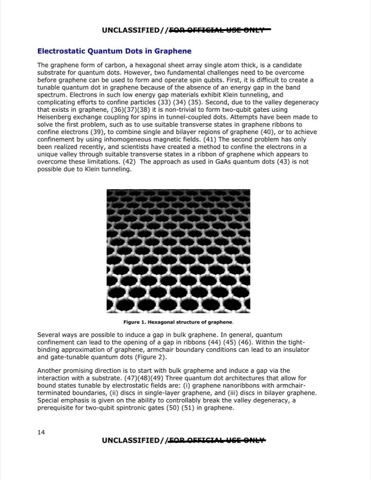
Image from page 15 of DOW-UAP-D150, as released by war.gov
Image from page 15 of the PDF. Open the scan to see the whole page.

Cite this page

U.S. Department of War. "AAWSAP DIRD, Quantum Computing and Utilizing Organic Molecules in Automation Technology, December 2010" (DOW-UAP-D150). PURSUE Release 06, U.S. Department of War, September 18, 2026. https://www.war.gov/medialink/ufo/sept-18/release-06/assets/DOW-UAP-D150_AAWSAP-DIRD-Quantum-Computing-and-Utilizing-Organic-Molecules-in-Automation-Technology-December-10-2010.pdf. Declassified UAP, page 15, https://declassifieduap.org/r/dow-uap-d150-aawsap-dird-quantum-computing-and-utilizing-organic-molecules-in-automation-technology-december-2010/p/15. Accessed November 28, 2026.

This address shows page 15 on its own; /r/dow-uap-d150-aawsap-dird-quantum-computing-and-utilizing-organic-molecules-in-automation-technology-december-2010?page=15 opens the same page in the full reader. Both stay. How to cite.