DOW-UAP-D148

AAWSAP DIRD, Detection and High-Resolution Tracking of Vehicles at Hypersonic Velocities, November 2010, page 14

One page of a U.S. government record released under PURSUE, shown on its own with its text. The record page has the whole document, its catalog details and the scan.

Page
14 of 46
Agency
Department of War
Released
Release 06, September 18, 2026

Text of page 14

UNCLASSIFIED FOR OFFICIAL USE ONLY Chapter 2: Hypersonic Compressible Flow Theory Hypersonic flow is typically assumed to apply to objects traveling at M > 5. Figure 6 shows that, for Mach numbers above 5, the ratio of Mach numbers across the shock approaches a constant value of 0.378, although temperature and pressure ratios continue to increase. In hypersonic flow, the bow shock, or Mach angle, B, approaches the half-angle, 0, of slender airfoils and the drag coefficient reaches a constant value that does not change with Mach number. The drag coefficient actually becomes a simple function of the half-angle of the airfoil, and the boundary layer is squeezed between the shockwave and the airfoil surface. 150, 100 Tratio (M) Pratio (M) 50 -0.9 -0.8 -0.7 10.6 -0.5 M 2(M) 0.4 10.3 -0.2 -0.1 5 7 8 9 Figure 6. Ratios of Mach Number, Temperature, and Pressure Across a Normal Shock In hypersonic flow, the Rankine-Hugoniot equations, which are based on the perfect gas law (p = pRT), fail to predict the real behavior of air at extremely high temperatures. Equation 12, for example, predicts a temperature of 29,787° C in the air near the surface of a blunt object traveling at the reentry Mach number of 26.5, while the actual temperature only reaches 7,600° C. The reason for this discrepancy is due to ionization of molecules of air as electrons are stripped away by the high temperatures that exist across the shock. Some energy is used to produce this ionization, and above temperatures of 550° C, equation 15 does not accurately predict air temperatures due to shocks. Ionization is responsible for the glowing wake that follows reentry vehicles and meteors as electrons rush to recombine with ions releasing x-rays and visible light. The ionization also interferes with radio transmissions, but provides a convenient way to identify hypersonic objects due to the emitted light. A "rule of thumb" is that the peak shock layer temperature in degrees kelvin is 1,000 times larger than the aircraft speed in km/s. By this standard, a reentry vehicle at 8 km/s (Mach 26.5) would have a maximum shock layer temperature of 8,000 K. At temperatures above 2,000 K, nitrogen and oxygen gas in the form of O2 and N2 will disassociate into individual ions, consuming more energy from the flow. 10 UNCLASSIFIED /FOR OFFI AL USE ONLY

Machine-read (OCR) from the scan by this archive; it can contain errors. The scan is the record.
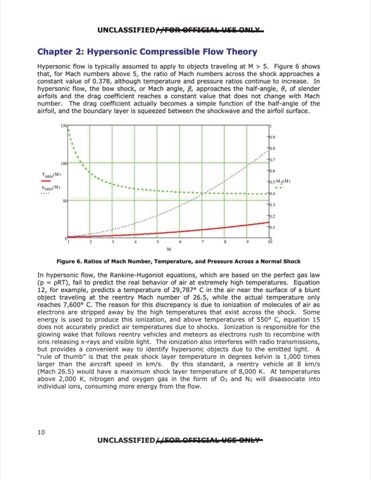
Image from page 14 of DOW-UAP-D148, as released by war.gov
Image from page 14 of the PDF. Open the scan to see the whole page.

Cite this page

U.S. Department of War. "AAWSAP DIRD, Detection and High-Resolution Tracking of Vehicles at Hypersonic Velocities, November 2010" (DOW-UAP-D148). PURSUE Release 06, U.S. Department of War, September 18, 2026. https://www.war.gov/medialink/ufo/sept-18/release-06/assets/DOW-UAP-D148_AAWSAP-DIRD-Detection-and-High-Resolution-Tracking-of-Vehicles-at-Hypersonic-Velocities-November-20-2010.pdf. Declassified UAP, page 14, https://declassifieduap.org/r/dow-uap-d148-aawsap-dird-detection-and-high-resolution-tracking-of-vehicles-at-hypersonic-velocities-november-2010/p/14. Accessed November 28, 2026.

This address shows page 14 on its own; /r/dow-uap-d148-aawsap-dird-detection-and-high-resolution-tracking-of-vehicles-at-hypersonic-velocities-november-2010?page=14 opens the same page in the full reader. Both stay. How to cite.