DOW-UAP-D148

AAWSAP DIRD, Detection and High-Resolution Tracking of Vehicles at Hypersonic Velocities, November 2010, page 13

One page of a U.S. government record released under PURSUE, shown on its own with its text. The record page has the whole document, its catalog details and the scan.

Page
13 of 46
Agency
Department of War
Released
Release 06, September 18, 2026

Text of page 13

UNCLASSIFIED FOR OFFICIAL USE ONLY These eations he be expressed in torto bere up statia of densty, ter, Mrature, and M2 = M, (11) 2 I2 = T, 2Y (M3-1) 2+ (r-1) M3 (12) y + 1 (r + 1) M? P2 = 1+ 2Y. (M7 -1) (13) PI y + 1 P2 = (r+ 1)M} (14) 2 + (y - 1) M3 As an example, if the object shown in figure 4 is traveling at Mach 3 through air at sea level, the pressure in the region between the nose of the object and the shock changes as shown in the following table: Table 1: Normal Shock Values for Mach 3 Flow Freestream Values Ratio of Properties Across the Normal Shock Values Downstream of the Normal Shock M1 = 3 P1 = 101,325 Pa T1 = 293 K = (20°C) P1 = 1.293 kg/m M2/M, = 0.158 P2/ P1 = 10.333 T2/T1 = 2.679 P2/P1 = 3.857 M, = 0.475 P2 = 1,047,000 Pa T2 = 785.0 K = (512°C) P2 = 4.976 kg/m3 For a normal shock, the Mach number on the downstream side of the shock is always subsonic, and in this example, the Mach number abruptly drops from M1 = 3 to M2 = 0.475. The temperature always increases across a shock, and for a Mach 3 flow, the temperature rises from room temperature at 20° C up to 512° C. It is apparent that, for supersonic aircraft traveling at this speed, the fuselage and wings will need to be made of materials that can withstand the high temperatures and the dramatic pressure increase of 10.333. Shocks are always accompanied by significant increases in pressure, temperature, and density in the flow across the shock. Flow about an Ogive or wedge-shaped airfoil as shown in Figure 4 can be analyzed in a similar fashion; however, the wall deflection angle, 0, will affect the flow and the formation of the oblique shock wave that surrounds the airfoil. 9 UNCLASSIFIED /FOR OFFICIAL USE ONLY

Machine-read (OCR) from the scan by this archive; it can contain errors. The scan is the record.
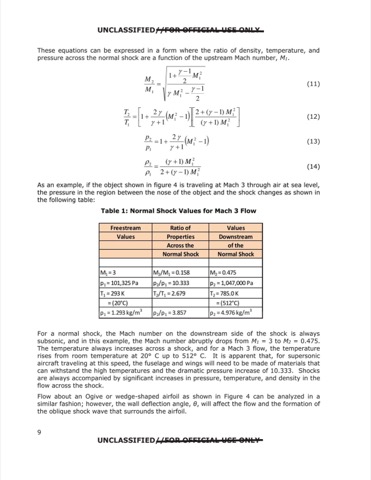
Image from page 13 of DOW-UAP-D148, as released by war.gov
Image from page 13 of the PDF. Open the scan to see the whole page.

Cite this page

U.S. Department of War. "AAWSAP DIRD, Detection and High-Resolution Tracking of Vehicles at Hypersonic Velocities, November 2010" (DOW-UAP-D148). PURSUE Release 06, U.S. Department of War, September 18, 2026. https://www.war.gov/medialink/ufo/sept-18/release-06/assets/DOW-UAP-D148_AAWSAP-DIRD-Detection-and-High-Resolution-Tracking-of-Vehicles-at-Hypersonic-Velocities-November-20-2010.pdf. Declassified UAP, page 13, https://declassifieduap.org/r/dow-uap-d148-aawsap-dird-detection-and-high-resolution-tracking-of-vehicles-at-hypersonic-velocities-november-2010/p/13. Accessed November 28, 2026.

This address shows page 13 on its own; /r/dow-uap-d148-aawsap-dird-detection-and-high-resolution-tracking-of-vehicles-at-hypersonic-velocities-november-2010?page=13 opens the same page in the full reader. Both stay. How to cite.