Text of page 9
UNCLASSIFIEDT FOR OFFIETAL UST ONLT
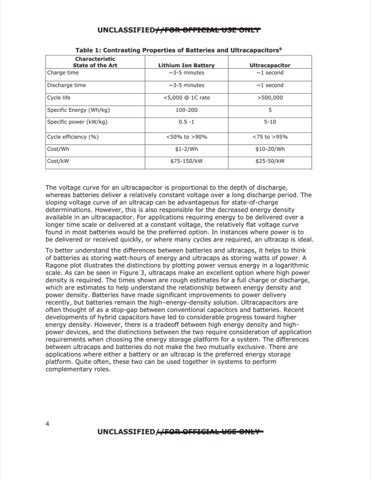
Table 1: Contrasting Properties of Batteries and Ultracapacitors®
Characteristic
State of the Art
Charge time
Lithium Ion Battery
~3-5 minutes
Discharge time
Cycle life
Specific Energy (Wh/kg)
Specific power (kW/kg)
~3-5 minutes
<5,000 @ 1C rate
100-200
0.5 -1
Ultracapacitor
~1 second
~1 second
>500,000
5
5-10
Cycle efficiency (%)
Cost/Wh
Cost/kW
<50% to >90%
$1-2/Wh
$75-150/kW
<75 to >95%
$10-20/Wh
$25-50/kW
The voltage curve for an ultracapacitor is proportional to the depth of discharge,
whereas batteries deliver a relatively constant voltage over a long discharge period. The
sloping voltage curve of an ultracap can be advantageous for state-of-charge
determinations. However, this is also responsible for the decreased energy density
available in an ultracapacitor. For applications requiring energy to be delivered over a
longer time scale or delivered at a constant voltage, the relatively flat voltage curve
found in most batteries would be the preferred option. In instances where power is to
be delivered or received quickly, or where many cycles are required, an ultracap is ideal.
To better understand the differences between batteries and ultracaps, it helps to think
of batteries as storing watt-hours of energy and ultracaps as storing watts of power. A
Ragone plot illustrates the distinctions by plotting power versus energy in a logarithmic
scale. As can be seen in Figure 3, ultracaps make an excellent option where high power
density is required. The times shown are rough estimates for a full charge or discharge,
which are estimates to help understand the relationship between energy density and
power density. Batteries have made significant improvements to power delivery
recently, but batteries remain the high-energy-density solution. Ultracapacitors are
often thought of as a stop-gap between conventional capacitors and batteries. Recent
developments of hybrid capacitors have led to considerable progress toward higher
energy density. However, there is a tradeoff between high energy density and high-
power devices, and the distinctions between the two require consideration of application
requirements when choosing the energy storage platform for a system. The differences
between ultracaps and batteries do not make the two mutually exclusive. There are
applications where either a battery or an ultracap is the preferred energy storage
platform. Quite often, these two can be used together in systems to perform
complementary roles.
4
UNCLASSIFIED//FOR OFFICIAL USE ONLY