DOW-UAP-D147

AAWSAP DIRD, Ultracapacitors as Energy and Power Storage Devices, November 2010, page 10

One page of a U.S. government record released under PURSUE, shown on its own with its text. The record page has the whole document, its catalog details and the scan.

Page
10 of 34
Agency
Department of War
Released
Release 06, September 18, 2026

Text of page 10

UNCLASSIFIEDT FOR OFFIETAL USE ONLY Energy density (Wh/kg) 1000 100 10 1 0.1 0.01 10 Fuel cells Conventional batteries 1 hour 10 hours 1 second Ut acapacitors 0.03 second Conventional Capacitors 10000 100 1000 Power density (W/kg) Figure 3. Ragone Plot. The graph illustrates the areas where ultracaps and batteries dominate in the power density versus energy density relationship. HISTORY The concept of storing electrical energy in the electric double layer that is formed at the interface between an electrolyte and a solid has been known since the late 1800s. In 1966, Standard Oil Company of Ohio (SOHIO) invented the device in the format now commonly used, which forms the basis for hundreds of patents and thousands of journal articles. Figure 4 shows a drawing from the electrochemical double-layer device invented by SOHIO. NEC introduced the SuperCapacitor™ in 1978 under license from SOHIO. CONDUCTOR CONDUCTOR POROUS GRAPHITE ELECTRODE - POROUS GRAPHITE - ELECTRODE SAT. A12(504)3 SOLUTION • - - - ION PERMEABLE MEMBRANE Figure 4. Electrolytic Capacitor as Designed and Patented by SOHIO. From this point on, ultracaps have rapidly evolved through several generations of designs. In the 1980s, Matsushita Electric Company developed a method of manufacturing ultracapacitors with improved electrodes. Initially, they were used as backup power devices for volatile clock chips and complementary metal-oxide- semiconductor (CMOS) computer memories. As the technology became more understood, more and more applications were developed for ultracaps. Many other applications have emerged over the past 30 years, including wireless communication, power quality, and improved energy efficiency through regenerative energy capture processes, as found in hybrid electric vehicles. 10 UNCLASSIFIED//FOR OFFICIAL USE ONLY 5

Machine-read (OCR) from the scan by this archive; it can contain errors. The scan is the record.
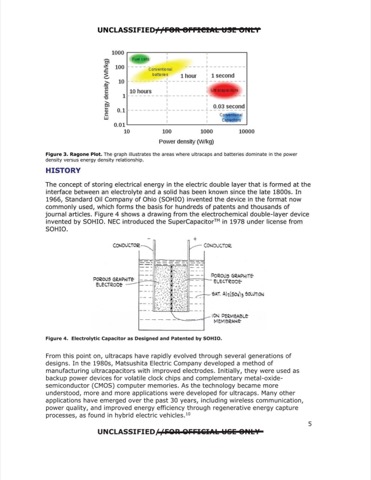
Image from page 10 of DOW-UAP-D147, as released by war.gov
Image from page 10 of the PDF. Open the scan to see the whole page.

Cite this page

U.S. Department of War. "AAWSAP DIRD, Ultracapacitors as Energy and Power Storage Devices, November 2010" (DOW-UAP-D147). PURSUE Release 06, U.S. Department of War, September 18, 2026. https://www.war.gov/medialink/ufo/sept-18/release-06/assets/DOW-UAP-D147_AAWSAP-DIRD-Ultracapacitors-as-Energy-and-Power-Storage-Devices-November-1-2010.pdf. Declassified UAP, page 10, https://declassifieduap.org/r/dow-uap-d147-aawsap-dird-ultracapacitors-as-energy-and-power-storage-devices-november-2010/p/10. Accessed November 28, 2026.

This address shows page 10 on its own; /r/dow-uap-d147-aawsap-dird-ultracapacitors-as-energy-and-power-storage-devices-november-2010?page=10 opens the same page in the full reader. Both stay. How to cite.