Text of page 15
UNCLASSIFIEDT FOR OFFIETAL UST ONLT
Activated carbons are synthesized by a heat treatment of carbon-rich organic
precursors in a controlled atmosphere. This carbonization process can be performed
from natural sources, such as fruit shells, wood, pitch, or coke. Activated carbons can
also be produced from synthetic precursors, such as select polymers. The heat
treatment process uses a controlled partial oxidation of the precursor combined with a
high-temperature processing. The high-temperature processing can be done in an inert
atmosphere, an oxidizing environment, or with a chemical modification. The activated
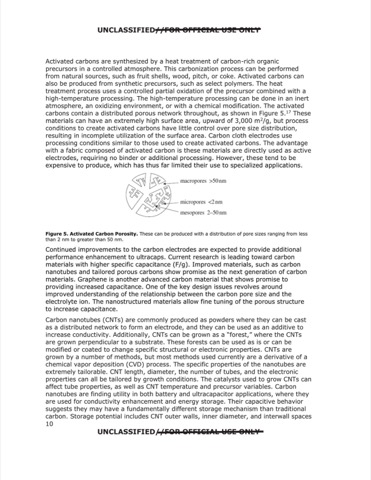
carbons contain a distributed porous network throughout, as shown in Figure 5.17 These
materials can have an extremely high surface area, upward of 3,000 mg, but process
conditions to create activated carbons have little control over pore size distribution,
resulting in incomplete utilization of the surface area. Carbon cloth electrodes use
processing conditions similar to those used to create activated carbons. The advantage
with a fabric composed of activated carbon is these materials are directly used as active
electrodes, requiring no binder or additional processing. However, these tend to be
expensive to produce, which has thus far limited their use to specialized applications.
macropores >50 nm
micropores <2 nm
mesopores 2-50 mm
Figure 5. Activated Carbon Porosity. These can be produced with a distribution of pore sizes ranging from less
than 2 mm to greater than 50 nm.
Continued improvements to the carbon electrodes are expected to provide additional
performance enhancement to ultracaps. Current research is leading toward carbon
materials with higher specific capacitance (F/g). Improved materials, such as carbon
nanotubes and tailored porous carbons show promise as the next generation of carbon
materials. Graphene is another advanced carbon material that shows promise to
providing increased capacitance. One of the key design issues revolves around
improved understanding of the relationship between the carbon pore size and the
electrolyte ion. The nanostructured materials allow fine tuning of the porous structure
to increase capacitance.
Carbon nanotubes (CNTs) are commonly produced as powders where they can be cast
as a distributed network to form an electrode, and they can be used as an additive to
increase conductivity. Additionally, CNTs can be grown as a "forest," where the CNTs
are grown perpendicular to a substrate. These forests can be used as is or can be
modified or coated to change specific structural or electronic properties. CNTs are
grown by a number of methods, but most methods used currently are a derivative of a
chemical vapor deposition (CVD) process. The specific properties of the nanotubes are
extremely tailorable. CNT length, diameter, the number of tubes, and the electronic
properties can all be tailored by growth conditions. The catalysts used to grow CNTs can
affect tube properties, as well as CNT temperature and precursor variables. Carbon
nanotubes are finding utility in both battery and ultracapacitor applications, where they
are used for conductivity enhancement and energy storage. Their capacitive behavior
suggests they may have a fundamentally different storage mechanism than traditional
carbon. Storage potential includes CNT outer walls, inner diameter, and interwall spaces
10
UNCLASSIFIED//FOR OFFICIAL USE ONLY