DOW-UAP-D147

AAWSAP DIRD, Ultracapacitors as Energy and Power Storage Devices, November 2010, page 14

One page of a U.S. government record released under PURSUE, shown on its own with its text. The record page has the whole document, its catalog details and the scan.

Page
14 of 34
Agency
Department of War
Released
Release 06, September 18, 2026

Text of page 14

UNCLASSIFIEDT FOR OFFIETAL USE ONLY ELECTRODES Carbon has been the optimal electrode material for ultracapacitors since their commercial introduction over 30 years ago. Pseudocapacitor systems use a combination of a carbon electrode and a battery-like electrode, such as a conductive polymer or a metal oxide. The high surface area of carbon makes it an extremely attractive option for ultracap electrodes. Carbon chemistry is quite well known, and high surface area and low cost ensures carbon's continued use for the near future. While carbon has been used in electrochemical systems for many years, there are many nuances that make its properties and performance vary significantly amongst the many types of carbon. The use of a carbon electrode makes ultracaps affordable for use in many systems. Activated carbon is readily available, can be made from many source materials, and is inexpensive. Materials science activities for electrodes are focused on improving the carbon electrodes and introducing alternative materials to create an asymmetric electrode. Types of carbon can include activated carbon, carbon cloth, aerogels, porous carbon, carbon nanotubes, and graphene. The properties of carbon can change dramatically based upon processing, having a major impact to the porosity and active surface area. Activated carbon has an extremely high surface area, is inexpensive, and is produced at a global scale for use in a number of applications. For these reasons, activated carbon is the traditional carbon of choice for ultracapacitor applications. Recent advances in carbon materials development have led to a number of options for ultracapacitor electrodes. Table 4 demonstrates a number of electrode materials in use today and the corresponding performance of these ultracaps. Table 4: Properties of Various Materials Used in Electrochemical Capacitor Electrode Materials16 Material Activated Carbon Carbon Cloth Aerogel Carbon Porous Carbon from SiC Porous Carbon from TiC Anhydrous RuOz Hydrous RuOz Doped Conductive Polymer Density (g/cm3) 0.7 0.35 0.6 0.7 0.5 2.7 2.0 0.7 Electrolyte KOH Organic KOH Organic KOH Organic KOH Organic KOH Organic Sulfuric Acid Sulfuric Acid Organic F/ g 160 100 200 100 75 125 175 100 220 120 150 650 450 9 UNCLASSIFIED//FOR OFFICIAL USE-©NLY

Machine-read (OCR) from the scan by this archive; it can contain errors. The scan is the record.
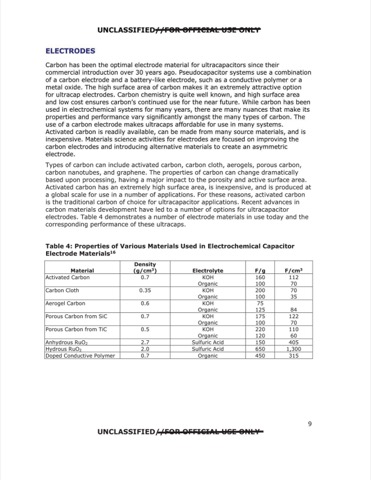
Image from page 14 of DOW-UAP-D147, as released by war.gov
Image from page 14 of the PDF. Open the scan to see the whole page.

Cite this page

U.S. Department of War. "AAWSAP DIRD, Ultracapacitors as Energy and Power Storage Devices, November 2010" (DOW-UAP-D147). PURSUE Release 06, U.S. Department of War, September 18, 2026. https://www.war.gov/medialink/ufo/sept-18/release-06/assets/DOW-UAP-D147_AAWSAP-DIRD-Ultracapacitors-as-Energy-and-Power-Storage-Devices-November-1-2010.pdf. Declassified UAP, page 14, https://declassifieduap.org/r/dow-uap-d147-aawsap-dird-ultracapacitors-as-energy-and-power-storage-devices-november-2010/p/14. Accessed November 28, 2026.

This address shows page 14 on its own; /r/dow-uap-d147-aawsap-dird-ultracapacitors-as-energy-and-power-storage-devices-november-2010?page=14 opens the same page in the full reader. Both stay. How to cite.