Text of page 13
UNCLASSIFIED//TOR VI
At USE ONLY
The perennial challenge for developing such a device into a power reactor is the feat of
manufacturing and compressing 10 such 1-mm DT fuel pellets per second. One
significant problem is maintaining equal pressure on the pellets repeatedly to permit
energy production.
ELECTROSTATIC CONFINEMENT
This simple method of confinement is composed of concentric spheres (or sometimes
cylinders) acting as anode and cathode in a vacuum known as a Farnsworth-Hirsch
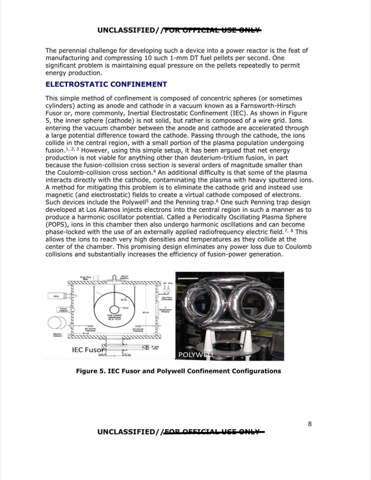
Fusor or, more commonly, Inertial Electrostatic Confinement (IEC). As shown in Figure
5, the inner sphere (cathode) is not solid, but rather is composed of a wire grid. Ions
entering the vacuum chamber between the anode and cathode are accelerated through
a large potential difference toward the cathode. Passing through the cathode, the ions
collide in the central region, with a small portion of the plasma population undergoing
fusion. 1, 2, 3 However, using this simple setup, it has been argued that net energy
production is not viable for anything other than deuterium-tritium fusion, in part
because the fusion-collision cross section is several orders of magnitude smaller than
the Coulomb-collision cross section. An additional difficulty is that some of the plasma
interacts directly with the cathode, contaminating the plasma with heavy sputtered ions.
A method for mitigating this problem is to eliminate the cathode grid and instead use
magnetic (and electrostatic) fields to create a virtual cathode composed of electrons.
Such devices include the Polywells and the Penning trap.© One such Penning trap design
developed at Los Alamos injects electrons into the central region in such a manner as to
produce a harmonic oscillator potential. Called a Periodically Oscillating Plasma Sphere
(POPS), ions in this chamber then also undergo harmonic oscillations and can become
phase-locked with the use of an externally applied radiofrequency electric field.7, 8 This
allows the ions to reach very high densities and temperatures as they collide at the
center of the chamber. This promising design eliminates any power loss due to Coulomb
collisions and substantially increases the efficiency of fusion-power generation.
IEC Fusor
Exis
POLYWES
Figure 5. IEC Fusor and Polywell Confinement Configurations
8
UNCLASSIFIED//EOR
AL USE ONLY