Text of page 12
UNCLASSIFIED/ /FOR O
USE ONLY
A spheromak is a tokomak in a
Plasma
Field Reversed
Configuration
spherical chamber that uses only a
Separatrix
single set of coils in conjunction with
plasma currents that self-generate a
confining magnetic field. However,
B=0
this design is thought to be less
€
promising than the previously
described technologies for
generating significant fusion energy.
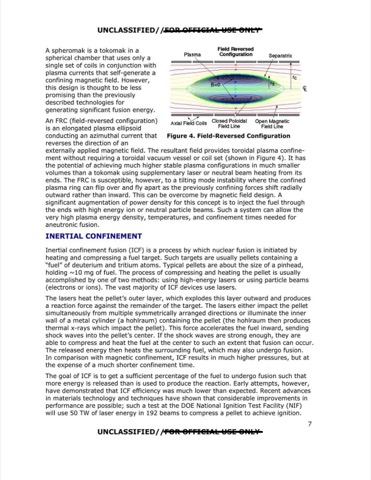
An FRC (field-reversed configuration)
is an elongated plasma ellipsoid
conducting an azimuthal current that
Axial Field Coils
Closed Poloidal
Open Magnetic
Field Line
Field Line
Figure 4. Field-Reversed Configuration
reverses the direction of an
externally applied magnetic field. The resultant field provides toroidal plasma confine-
ment without requiring a toroidal vacuum vessel or coil set (shown in Figure 4). It has
the potential of achieving much higher stable plasma configurations in much smaller
volumes than a tokomak using supplementary laser or neutral beam heating from its
ends. The FRC is susceptible, however, to a tilting mode instability where the confined
plasma ring can flip over and fly apart as the previously confining forces shift radially
outward rather than inward. This can be overcome by magnetic field design. A
significant augmentation of power density for this concept is to inject the fuel through
the ends with high energy ion or neutral particle beams. Such a system can allow the
very high plasma energy density, temperatures, and confinement times needed for
aneutronic fusion.
INERTIAL CONFINEMENT
Inertial confinement fusion (ICF) is a process by which nuclear fusion is initiated by
heating and compressing a fuel target. Such targets are usually pellets containing a
"fuel" of deuterium and tritium atoms. Typical pellets are about the size of a pinhead,
holding ~10 mg of fuel. The process of compressing and heating the pellet is usually
accomplished by one of two methods: using high-energy lasers or using particle beams
(electrons or ions). The vast majority of IC devices use lasers.
The lasers heat the pellet's outer layer, which explodes this layer outward and produces
a reaction force against the remainder of the target. The lasers either impact the pellet
simultaneously from multiple symmetrically arranged directions or illuminate the inner
wall of a metal cylinder (a hohlraum) containing the pellet (the hohlraum then produces
thermal x-rays which impact the pellet). This force accelerates the fuel inward, sending
shock waves into the pellet's center. If the shock waves are strong enough, they are
able to compress and heat the fuel at the center to such an extent that fusion can occur.
The released energy then heats the surrounding fuel, which may also undergo fusion.
In comparison with magnetic confinement, IC results in much higher pressures, but at
the expense of a much shorter confinement time.
The goal of IC is to get a sufficient percentage of the fuel to undergo fusion such that
more energy is released than is used to produce the reaction. Early attempts, however,
have demonstrated that ICF efficiency was much lower than expected. Recent advances
in materials technology and techniques have shown that considerable improvements in
performance are possible; such a test at the DOE National Ignition Test Facility (NIF)
will use 50 TW of laser energy in 192 beams to compress a pellet to achieve ignition.
7
UNCLASSIFIED//FOR eI
AL USE ONLY