Text of page 9
UNCLASSIFIED/TTOR OFFFETAL USE ONLY
Chapter 1: Theory
ROCKET PROPULSION
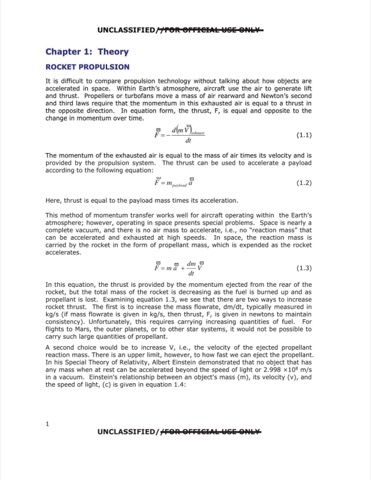
It is difficult to compare propulsion technology without talking about how objects are
accelerated in space. Within Earth's atmosphere, aircraft use the air to generate lift
and thrust. Propellers or turbofans move a mass of air rearward and Newton's second
and third laws require that the momentum in this exhausted air is equal to a thrust in
the opposite direction. In equation form, the thrust, F, is equal and opposite to the
change in momentum over time.
F = -
(1.1)
dt
The momentum of the exhausted air is equal to the mass of air times its velocity and is
provided by the propulsion system. The thrust can be used to accelerate a payload
according to the following equation:
F = m
payload a
(1.2)
Here, thrust is equal to the payload mass times its acceleration.
This method of momentum transfer works well for aircraft operating within the Earth's
atmosphere; however, operating in space presents special problems. Space is nearly a
complete vacuum, and there is no air mass to accelerate, i.e., no "reaction mass" that
can be accelerated and exhausted at high speeds. In space, the reaction mass is
carried by the rocket in the form of propellant mass, which is expended as the rocket
accelerates.
dm
F = m a
+
(1.3)
In this equation, the thrust is provided by the momentum ejected from the rear of the
rocket, but the total mass of the rocket is decreasing as the fuel is burned up and as
propellant is lost. Examining equation 1.3, we see that there are two ways to increase
rocket thrust. The first is to increase the mass florate, dm/dt, typically measured in
kg/s (if mass flowrate is given in kg/s, then thrust, F, is given in newtons to maintain
consistency). Unfortunately, this requires carrying increasing quantities of fuel. For
flights to Mars, the outer planets, or to other star systems, it would not be possible to
carry such large quantities of propellant.
A second choice would be to increase V, i.e., the velocity of the ejected propellant
reaction mass. There is an upper limit, however, to how fast we can eject the propellant.
In his Special Theory of Relativity, Albert Einstein demonstrated that no object that has
any mass when at rest can be accelerated beyond the speed of light or 2.998 x10⁸ m/s
in a vacuum. Einstein's relationship between an object's mass (m), its velocity (v), and
the speed of light, (c) is given in equation 1.4:
1
UNCLASSIFIED//FOR OFFICIAL USE ONLY