DOW-UAP-D145

AAWSAP DIRD, Aneutronic Fusion Propulsion I, November 2010, page 8

One page of a U.S. government record released under PURSUE, shown on its own with its text. The record page has the whole document, its catalog details and the scan.

Page
8 of 50
Agency
Department of War
Released
Release 06, September 18, 2026

Text of page 8

UNCLASSIFIED/TFOR OFFICIAL USE ONLY space ship, and there is a high probability that neutrons produced by fusion reactors would escape into space without providing much of their energy to a hydrogen propellant. Other fusion reactions using isotopes of helium and lithium will generate only charged particles, such as protons, that travel very short distances before giving up all of their energy as heat. These "aneutronic fusion" reactions take place without neutron production and decrease the need to carry large amounts of radiation shielding material for the crew. The energy from charged particles generated by aneutronic fusion can also be captured in conductive coils and converted directly into electricity. Aneutronic fusion promises to be an important mechanism for future space propulsion, although novel accelerator or laser systems must be researched and developed in order to initiate, sustain, and control the fusion reaction. Another futuristic method of spacecraft propulsion involves the use of antimatter. Antimatter includes antiprotons, antineutrons, and positrons (anti-electrons). Although this propulsion process may be the most efficient, antimatter has some drawbacks. For example, antimatter is generated in only minute quantities at accelerator facilities around the world. Although it has been captured and stored, containment remains a problem. When antimatter combines with matter, it completely annihilates and converts to energy, which then can be converted into heat for a propulsion system. Antimatter reactions provide the greatest amount of energy per unit mass of any potential fuel, but the ability to generate significant quantities of antihydrogen or similar antimatter fuels at any accelerator facility is very limited. The focus of this study is on aneutronic fusion propulsion. Integral to this study are the topics of fuel, rocket design, and the organizations that research aneutronic fusion development. Liquid H, LOX , Turbopumps Combustion Chamber Laval Nozzle Figure 1. Liquid-Fueled Chemical Rocket. UNCLASSIFIED//FOR OFFICIAL USE ONLY

Machine-read (OCR) from the scan by this archive; it can contain errors. The scan is the record.
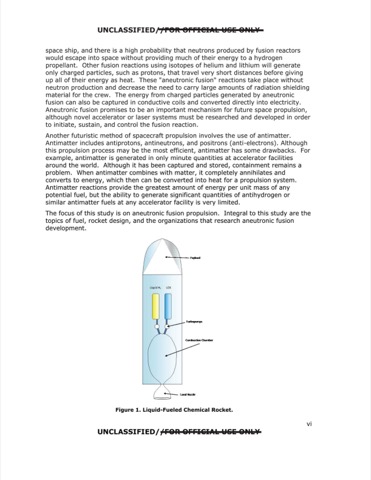
Image from page 8 of DOW-UAP-D145, as released by war.gov
Image from page 8 of the PDF. Open the scan to see the whole page.

Cite this page

U.S. Department of War. "AAWSAP DIRD, Aneutronic Fusion Propulsion I, November 2010" (DOW-UAP-D145). PURSUE Release 06, U.S. Department of War, September 18, 2026. https://www.war.gov/medialink/ufo/sept-18/release-06/assets/DOW-UAP-D145_AAWSAP-DIRD-Aneutronic-Fusion-Propulsion-I-November-1-2010.pdf. Declassified UAP, page 8, https://declassifieduap.org/r/dow-uap-d145-aawsap-dird-aneutronic-fusion-propulsion-i-november-2010/p/8. Accessed November 28, 2026.

This address shows page 8 on its own; /r/dow-uap-d145-aawsap-dird-aneutronic-fusion-propulsion-i-november-2010?page=8 opens the same page in the full reader. Both stay. How to cite.