Text of page 17
UNCLASSIFIED/FOR OFFFETAL USE ONLY
eur
(1.18)
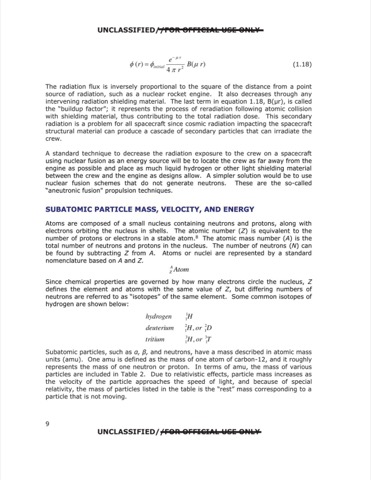
The radiation flux is inversely proportional to the square of the distance from a point
source of radiation, such as a nuclear rocket engine. It also decreases through any
intervening radiation shielding material. The last term in equation 1.18, B(ur), is called
the "buildup factor"; it represents the process of reradiation following atomic collision
with shielding material, thus contributing to the total radiation dose. This secondary
radiation is a problem for all spacecraft since cosmic radiation impacting the spacecraft
structural material can produce a cascade of secondary particles that can irradiate the
crew.
A standard technique to decrease the radiation exposure to the crew on a spacecraft
using nuclear fusion as an energy source will be to locate the crew as far away from the
engine as possible and place as much liquid hydrogen or other light shielding material
between the crew and the engine as designs allow. A simpler solution would be to use
nuclear fusion schemes that do not generate neutrons. These are the so-called
"aneutronic fusion" propulsion techniques.
SUBATOMIC PARTICLE MASS, VELOCITY, AND ENERGY
Atoms are composed of a small nucleus containing neutrons and protons, along with
electrons orbiting the nucleus in shells.
The atomic number (2) is equivalent to the
number of protons or electrons in a stable atom. The atomic mass number (A) is the
total number of neutrons and protons in the nucleus. The number of neutrons (N) can
be found by subtracting Z from A. Atoms or nuclei are represented by a standard
nomenclature based on A and Z.
2 Atom
Since chemical properties are governed by how many electrons circle the nucleus, Z
defines the element and atoms with the same value of Z, but differing numbers of
neutrons are referred to as "isotopes" of the same element. Some common isotopes of
hydrogen are shown below:
hydrogen H
deuterium 3H, or D
tritium
"H, or T
Subatomic particles, such as a, B, and neutrons, have a mass described in atomic mass
units (amu). One amu is defined as the mass of one atom of carbon-12, and it roughly
paries are he maed in Table Due to retativiti elects, particle mas increases us
the velocity of the particle approaches the speed of light, and because of special
relativity, the mass of particles listed in the table is the "rest" mass corresponding to a
particle that is not moving.
9
UNCLASSIFIED//FOR OFFICIAL USE ONLY