DOW-UAP-D145

AAWSAP DIRD, Aneutronic Fusion Propulsion I, November 2010, page 16

One page of a U.S. government record released under PURSUE, shown on its own with its text. The record page has the whole document, its catalog details and the scan.

Page
16 of 50
Agency
Department of War
Released
Release 06, September 18, 2026

Text of page 16

UNCLASSIFIED/TFOR OFFICIAL USE ONLY Long-duration spaceflights will require copious amounts of water for the crew, and water can be used to provide some shielding from neutrons for the astronauts. Shielding material for gamma rays presents a weight problem. Lead is one of the best shielding materials for gamma, but at a cost of about $10,000/Ib to launch material into space, lead shielding is expensive to use. The International Space Station and other spacecraft designed for long-term human habitation usually have a small area that is heavily shielded to prevent excessive radiation exposure to the crew during solar events. In addition to the dangers of natural sources of radiation in space that can endanger human health and safety, the propulsion techniques of nuclear fusion and fission generate large fluxes of radiation. Neutron production is of special concern because neutrons can penetrate metals and the structural material of space habitats. The general equations that govern radiation shielding can help develop spacecraft designs that will minimize radiation exposure. The intensity of gamma rays will attenuate according to the following equation: Ф (r) = initial Mr (1.17) In equation 1.17, the flux of gamma rays or neutrons, given in particles per unit area per unit time, is represented by @(r); initial represents the initial flux without the shielding; and y is the linear attenuation coefficient, a function of the gamma ray or neutron energy and the type of shielding material. The thickness of the material is represented by r. The radiation flux decreases with distance since photons or radioactive particles typically expand outward through a spherical area of 4r as shown in Figure 3. Equation 1.18 shows the relationship between total attenuation, particle flux, and radiation exposure. Radiation Shielding Material 4 = attenuation coefficent Ф(r)/initial → Figure 3. Spherical Radiation Shield Surrounding a Point Source. UNCLASSIFIED/+FOR OFFICIAL USE ONLY 8

Machine-read (OCR) from the scan by this archive; it can contain errors. The scan is the record.
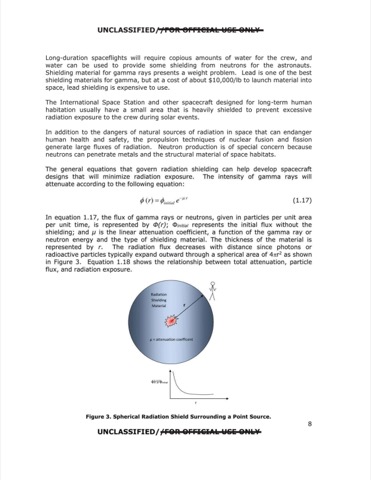
Image from page 16 of DOW-UAP-D145, as released by war.gov
Image from page 16 of the PDF. Open the scan to see the whole page.

Cite this page

U.S. Department of War. "AAWSAP DIRD, Aneutronic Fusion Propulsion I, November 2010" (DOW-UAP-D145). PURSUE Release 06, U.S. Department of War, September 18, 2026. https://www.war.gov/medialink/ufo/sept-18/release-06/assets/DOW-UAP-D145_AAWSAP-DIRD-Aneutronic-Fusion-Propulsion-I-November-1-2010.pdf. Declassified UAP, page 16, https://declassifieduap.org/r/dow-uap-d145-aawsap-dird-aneutronic-fusion-propulsion-i-november-2010/p/16. Accessed November 28, 2026.

This address shows page 16 on its own; /r/dow-uap-d145-aawsap-dird-aneutronic-fusion-propulsion-i-november-2010?page=16 opens the same page in the full reader. Both stay. How to cite.