DOW-UAP-D143

AAWSAP DIRD, Laser Lightcraft Nanosatellites, November 2010, page 64

One page of a U.S. government record released under PURSUE, shown on its own with its text. The record page has the whole document, its catalog details and the scan.

Page
64 of 77
Agency
Department of War
Released
Release 06, September 18, 2026

Text of page 64

UNCLASSIFIED TOR AL USE ONLY • Efficient, generally a FEL can transform 10% (> 60% for microwave tubes) of its energy into laser radiation. • Reliable, systems now run 24 hours per day for weeks. • Can produce picosecond laser pulse widths. • Systems are big (40 m x 60 m) and expensive ($1 Million to $100 Million). The Naval Sea Systems Command's (NAVSEA) Directed Energy and Electric Weapon Systems (DE&EWS) Program Office is supporting research, development and testing of advanced high-energy/high-power FEL designs for the purpose of deploying them as directed energy weapons onboard warships in the near future. The DE&EWS program is emphasizing the development of disruptive innovations to reduce FEL system size, weight, and operational (and lifetime) cost, as well as to increase overall system operating efficiency. One design that has emerged to reach all of these goals is the recirculating-beam FEL system (RBFEL), which uses a superconducting accelerator, RF power liquid helium refrigerator, an electron beam injector, an electron beam dump, and a modified laser resonator-undulator cavity that boosts the production of amplified, coherent laser photons (see Figure 31). The superconducting accelerator gives good efficiency and gradient while recirculation of the electron beam recovers beam energy to increase efficiency and reduce the beam dump size. Electron Accelerator Beam Dump RF Power Liquid Helium Refrigerator Injector 100000000 Reflecting Mirror Undulator 000000000 Out-Coupling Mirror Figure 31. Recirculating-Beam FEL System (courtesy of the Naval Post-Graduate School FEL Lab). The key (typical) technical features of the Navy RBFEL are as follows: Total system volume: 16 m x 4 m x 4 m = 256 m3. • Undulator/Wiggler Length: 46 cm to 60 cm. Period: 2.9 cm. Number of periods: 18. - Magnetic field strength: 1 Testa. 60 UNCLASSIFIED//FOR OFFICIAL USE ONLY

Machine-read (OCR) from the scan by this archive; it can contain errors. The scan is the record.
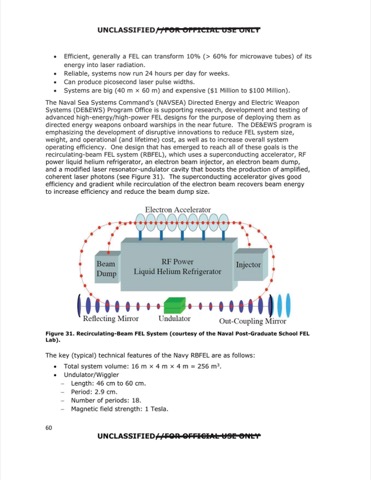
Image from page 64 of DOW-UAP-D143, as released by war.gov
Image from page 64 of the PDF. Open the scan to see the whole page.

Cite this page

U.S. Department of War. "AAWSAP DIRD, Laser Lightcraft Nanosatellites, November 2010" (DOW-UAP-D143). PURSUE Release 06, U.S. Department of War, September 18, 2026. https://www.war.gov/medialink/ufo/sept-18/release-06/assets/DOW-UAP-D143_AAWSAP-DIRD-Laser-Lightcraft-Nanosatellites-November-1-2010.pdf. Declassified UAP, page 64, https://declassifieduap.org/r/dow-uap-d143-aawsap-dird-laser-lightcraft-nanosatellites-november-2010/p/64. Accessed November 28, 2026.

This address shows page 64 on its own; /r/dow-uap-d143-aawsap-dird-laser-lightcraft-nanosatellites-november-2010?page=64 opens the same page in the full reader. Both stay. How to cite.