DOW-UAP-D143

AAWSAP DIRD, Laser Lightcraft Nanosatellites, November 2010, page 63

One page of a U.S. government record released under PURSUE, shown on its own with its text. The record page has the whole document, its catalog details and the scan.

Page
63 of 77
Agency
Department of War
Released
Release 06, September 18, 2026

Text of page 63

UNCLASSIFIED TOR OFTETAL USE UNDY electron beam undulator resonator mirror Z electron beam phase-space evolution Figure 30. Free-Electron Laser Electron Beam Phase-Space Evolution (courtesy of the Naval Post-Graduate School FEL Lab). In the quantum picture of how FELs operate, the "wiggling" electrons radiate light and that light then gets stored between the resonator mirrors. And additional light radiation (that enters the resonator) in the presence of "stored light" results in stimulated emission, which is the lasing process. The classical interpretation of this process is that the electrons travel with the light radiation and exchange energy with it. Some electrons gain energy while some lose energy to the light radiation. The electrons in the beam will "bunch" within each optical wavelength, thus these bunched electrons will radiate coherently to produce laser light. This mechanism is represented graphically in Figure 29 and Figure 30. The main appeal of free-electron lasers (FELs) is that they can be built for emission frequencies ranging from the terahertz region, through the infrared and visible spectrum, up to X-rays. Also, a single device often allows wavelength tuning over a large range and the output power can be scaled up very high. As in many spectral regions, it is not easy to make resonator mirrors; many FELs work without such mirrors and rely on amplified spontaneous emission. This can still be relatively efficient if the gain is high enough. One then actually has a superluminescent source. The big disadvantage of FELs is their very large and expensive setup; they can only be used at large facilities. The benefits of FELs are: • Continuously wavelength tunable, i.e., they can produce different wavelengths during operation. • Designable to produce a range of wavelengths, from microwaves to X-rays. • Scalable to very high beam power because they use a vacuum for their gain medium - laser medium cannot be damaged. • Not affected by heat problems that are common in other laser technologies. 59 UNCLASSIFIED//FOR OFFICIAL USE ONLY

Machine-read (OCR) from the scan by this archive; it can contain errors. The scan is the record.
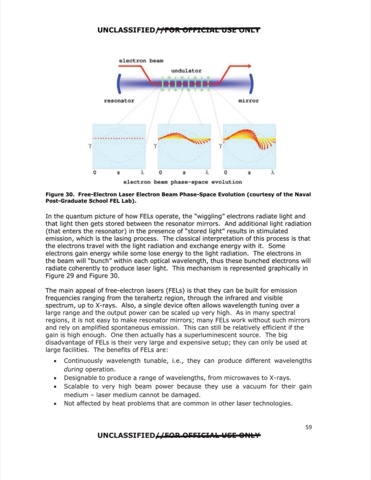
Image from page 63 of DOW-UAP-D143, as released by war.gov
Image from page 63 of the PDF. Open the scan to see the whole page.

Cite this page

U.S. Department of War. "AAWSAP DIRD, Laser Lightcraft Nanosatellites, November 2010" (DOW-UAP-D143). PURSUE Release 06, U.S. Department of War, September 18, 2026. https://www.war.gov/medialink/ufo/sept-18/release-06/assets/DOW-UAP-D143_AAWSAP-DIRD-Laser-Lightcraft-Nanosatellites-November-1-2010.pdf. Declassified UAP, page 63, https://declassifieduap.org/r/dow-uap-d143-aawsap-dird-laser-lightcraft-nanosatellites-november-2010/p/63. Accessed November 28, 2026.

This address shows page 63 on its own; /r/dow-uap-d143-aawsap-dird-laser-lightcraft-nanosatellites-november-2010?page=63 opens the same page in the full reader. Both stay. How to cite.