Text of page 28
UNCLASSIFIED/TOR OFFTETAL USE ONLY
6
Laser Power Captured by Lighteraft (MW)
50°
60°
•Radiated Laser
Power = 10 MW
70°
75°
Laser Beam
Angle from
the Vertical
4
lEnd of Laser'
"Airbreathing!
Propulsion
80°
3
1.62 micron
Laser Wavelength
2.9
83° MW
1
• Lightcraft
Lighteraft-
Capture Dia.
¡ Achievement of!
of 30 cm
Orbital Speed i
11.2 micron
Laser Wavelength -
.04
MW
0
-
100
200
300
400
Lighteraft Slant Range from Laser (km)
500
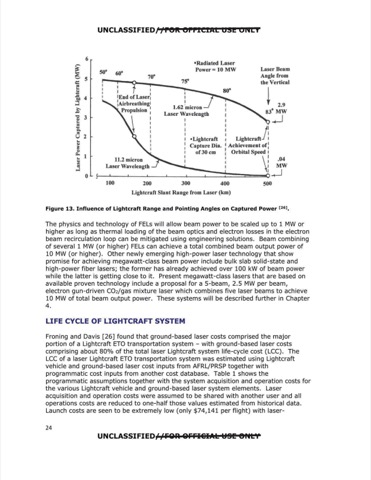
Figure 13. Influence of Lightcraft Range and Pointing Angles on Captured Power [261,
The physics and technology of FELs will allow beam power to be scaled up to 1 MW or
higher as long as thermal loading of the beam optics and electron losses in the electron
beam recirculation loop can be mitigated using engineering solutions. Beam combining
of several 1 MW (or higher) FELs can achieve a total combined beam output power of
10 MW (or higher). Other newly emerging high-power laser technology that show
promise for achieving megawatt-class beam power include bulk slab solid-state and
high-power fiber lasers; the former has already achieved over 100 kW of beam power
while the latter is getting close to it. Present megawatt-class lasers that are based on
available proven technology include a proposal for a 5-beam, 2.5 MW per beam,
electron gun-driven COz/gas mixture laser which combines five laser beams to achieve
10 MW of total beam output power. These systems will be described further in Chapter
4.
LIFE CYCLE OF LIGHTCRAFT SYSTEM
Froning and Davis [26] found that ground-based laser costs comprised the major
portion of a Lightcraft ETO transportation system - with ground-based laser costs
comprising about 80% of the total laser Lightcraft system life-cycle cost (LCC). The
LCC of a laser Lightcraft ETO transportation system was estimated using Lightcraft
vehicle and ground-based laser cost inputs from AFRL/PRSP together with
programmatic cost inputs from another cost database. Table 1 shows the
programmatic assumptions together with the system acquisition and operation costs for
the various Lightcraft vehicle and ground-based laser system elements. Laser
acquisition and operation costs were assumed to be shared with another user and all
operations costs are reduced to one-half those values estimated from historical data.
Launch costs are seen to be extremely low (only $74,141 per flight) with laser-
24
UNCLASSIFIED//FOR OFFICIAL USE ONLY