DOW-UAP-D143

AAWSAP DIRD, Laser Lightcraft Nanosatellites, November 2010, page 27

One page of a U.S. government record released under PURSUE, shown on its own with its text. The record page has the whole document, its catalog details and the scan.

Page
27 of 77
Agency
Department of War
Released
Release 06, September 18, 2026

Text of page 27

UNCLASSIFIED TOR OFTE AL USE ONLY Figure 12 shows, for a given laser aperture diameter, adaptive optics, and atmospheric conditions, the decrease in laser power collected by the Lightcraft with increasing range from a 11.2 um wavelength COz laser. The decrease is shown for a vertical laser- pointing angle and for a final laser-pointing angle of 83° (from the vertical) that occurs at maximum laser propulsion range (about 500 km), where the Lightcraft reaches maximum speed. 1.E+07 Laser Power Captured by Lighteraft (W) 11.2 micron Laser Wavelength Laser Beam Angle from the Vertical 1.E+06 1.E+05. 83° No Adaptive. Optics 83° 1.E+04+ 0 100 200 300 400 500 Lighteraft Slant Range from Laser (km) Figure 12. Captured Laser Power vs. Increasing Range from 11.2 um COz Laser [26], Figure 13 shows the significant difference in the laser power collected by the Lightcraft during its laser propulsion phase of flight for the selected laser wavelength of 1.62 um, and for the 11.2 um COz laser wavelength chosen for a government baseline Lightcraft. This comparison is for a Lightcraft trajectory determined from optimization work during the latter phases of the Froning and Davis study. It was also for the highest radiated power (10 MW) and the largest laser aperture (10 m) that was deemed practical for Air Force operations and systems. Unfortunately the demonstrated laser beam power levels for the attractive 1.62 um wavelength, which suffered the least propagation losses, are relatively modest. This attractive laser wavelength is associated with the wavelength-tunable free-electron laser (FEL), whose maximum beam power is currently in the 20 kW range. Thus, there is the need for a 500-fold increase in FEL beam power to achieve the 10 MW beam power required for (10 kg-class) Lightcraft ETO propulsion. However, 100 kW beam FEL designs are being proposed by the Navy for prototyping and testing in FY 2011 and 2012. 23 UNCLASSIFIED//FOR OFFICIAL USE ONLY

Machine-read (OCR) from the scan by this archive; it can contain errors. The scan is the record.
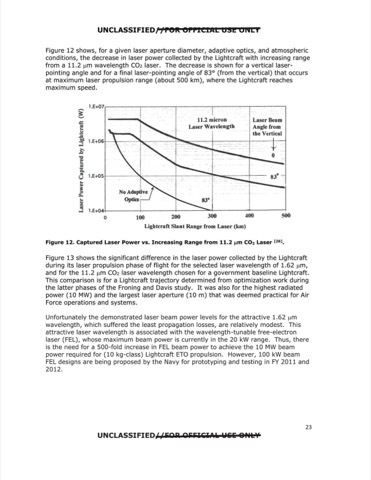
Image from page 27 of DOW-UAP-D143, as released by war.gov
Image from page 27 of the PDF. Open the scan to see the whole page.

Cite this page

U.S. Department of War. "AAWSAP DIRD, Laser Lightcraft Nanosatellites, November 2010" (DOW-UAP-D143). PURSUE Release 06, U.S. Department of War, September 18, 2026. https://www.war.gov/medialink/ufo/sept-18/release-06/assets/DOW-UAP-D143_AAWSAP-DIRD-Laser-Lightcraft-Nanosatellites-November-1-2010.pdf. Declassified UAP, page 27, https://declassifieduap.org/r/dow-uap-d143-aawsap-dird-laser-lightcraft-nanosatellites-november-2010/p/27. Accessed November 28, 2026.

This address shows page 27 on its own; /r/dow-uap-d143-aawsap-dird-laser-lightcraft-nanosatellites-november-2010?page=27 opens the same page in the full reader. Both stay. How to cite.